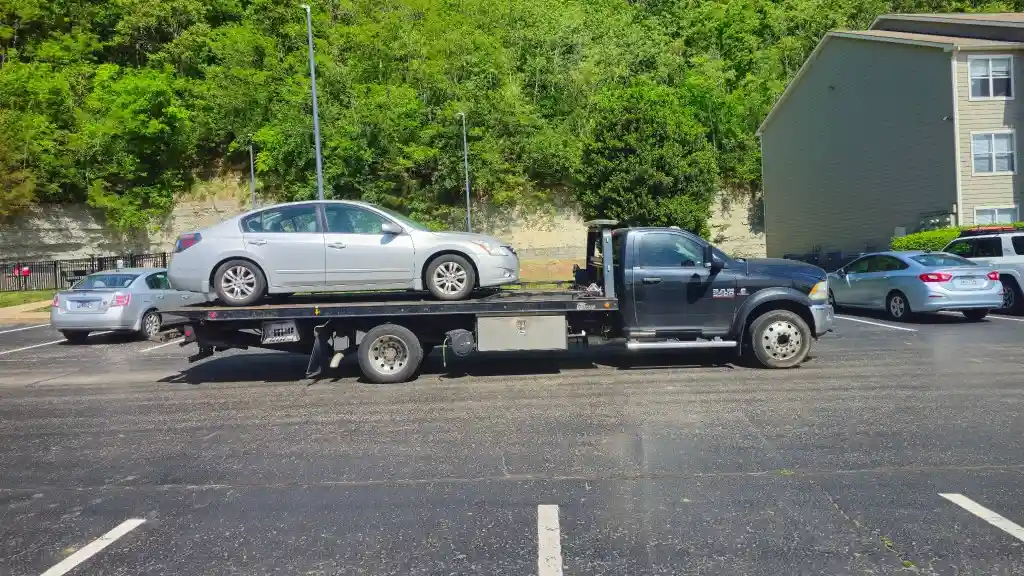
Page image supporting How to Tow a Tesla Safely — Nashville EV Flatbed Guide. A Nashville operator’s step-by-step for towing a Tesla safely — flatbed only…
Towing a Tesla in Nashville: The Only Safe Way to Do It
A Nashville operator’s step-by-step for towing a Tesla safely — flatbed only, transport mode, dead 12-volt fixes, and the loading mistakes that cost $14,000+.
The first time I loaded a Model S onto my flatbed at 2 a.m. on West End Avenue, the owner was standing in the drizzle refreshing the Tesla app and asking if I'd ever done it before. I had. But I understood the nervousness — the car cost more than my truck, and there's a specific way you're supposed to do this. Do it wrong and you're not looking at a $500 repair, you're looking at a $15,000 motor replacement.
If your Tesla is stuck on the shoulder of I-24 or dead in a parking garage downtown, here's exactly how it should be towed — and what to refuse if a driver shows up and starts doing it wrong.
Rule One: Flatbed Only, Every Time
Tesla is more specific than almost any other manufacturer on this. Every Model S, Model 3, Model X, Model Y, and Cybertruck must be transported on a flatbed with all four wheels off the ground. Not two wheels, not a wheel-lift with dollies under the drive wheels — a full flatbed.
The reason is simple: Teslas don't have a traditional transmission with a neutral gear that lets the wheels spin freely. The motor is directly connected to the drive wheels through a fixed reduction gear. When the car is powered off and you spin those wheels — by dragging it, by putting it on a dolly, by towing it two-down — you're back-driving the motor. That generates voltage into a system that's supposed to be off. It fries the motor controller. On dual-motor cars, it fries both.
Tesla's own owner's manual spells this out in the towing section. I've had owners argue with me on the roadside because "AAA said they could do it with a dolly." AAA might send you a driver who does that. It's still wrong. The bill for a motor and inverter replacement on a Model 3 Performance is currently around $14,000 parts and labor. A flatbed tow across Nashville is $150. Do the math.
Getting the Car Out of Park
Here's the part most non-EV drivers don't know about: a dead Tesla can't shift into neutral by itself. Regular cars have a mechanical override — a slot next to the shifter you pop with a key. Teslas are drive-by-wire, which means every gear change requires 12-volt power to the low-voltage systems. If the 12-volt battery is dead (which it often is, even when the main pack has charge), the parking pawl stays locked.
There are three real ways to solve this on the roadside:
Jump the 12-volt battery. Most Model S and X cars have a tow point access panel behind the front bumper cover — you pop it, hook to the exposed terminals, and give it 12 volts long enough to shift out of park. Model 3 and Y have terminals under the frunk trim you can reach after opening the frunk manually with a small hidden cable behind the tow eye cover.
Use transport mode. Once you have low-voltage power, you can enable transport mode from the touchscreen (Controls → Service → Towing → Transport Mode). This releases the parking brake and lets the wheels roll for a short distance at low speed — long enough to get onto the flatbed. Tesla explicitly limits this to about 30 feet at 3 mph.
Use skates. If neither of the above works, we put wheel skates under all four tires and roll the whole car onto the bed without any drivetrain rotation. Every good Tesla-capable operator carries a set. If your driver shows up without them and you can't get the car into transport mode, they can't safely load it — and dragging it up the bed with the wheels locked will scrape the tires, damage the wheel arches, and potentially bend the aluminum body.
The Battery Fire Question
You've probably seen the news stories about Tesla battery fires after crashes. Most are exaggerated, but there's one real concern for towing: if the high-voltage battery has been physically damaged in a collision, thermal runaway can develop hours or even days later. If you were in any kind of impact — even a mild fender-bender — tell the towing dispatcher. We'll transport it with extra clearance from other vehicles, sometimes stage it away from buildings on delivery, and give the receiving shop a heads-up.
An intact, undamaged Tesla is completely safe to transport. Millions of them get flatbedded every year without incident. The only special handling is when there's known battery damage.
What to Ask the Dispatcher
When you call for a Tesla tow, ask three questions:
- Is the truck a flatbed? Not a wheel-lift. Not a dolly. A flatbed. If they can't confirm, call someone else.
- Does the driver have wheel skates on the truck? If your 12-volt is dead and transport mode is unavailable, this is the only way to load safely.
- Do they know Tesla-specific loading points? Teslas have specific jack pucks and tow eyes designed for lifting. Random chains around a control arm will bend it.
A good dispatcher will answer all three without hesitation. If they get vague or defensive, that's your signal.
Nashville-Specific Situations I've Seen
Charging station strandings. A dead Tesla at an EA station off I-65 or a Tesla Supercharger downtown usually means either a failed 12-volt battery or a car that went into deep sleep with the pack at 0%. We can usually jump the 12-volt on the spot, get transport mode enabled, and either get you to the nearest working charger or to a service center.
Parking garage extractions. The Gulch garages and the ones under the Ryman-area buildings have low ceiling clearances. Some flatbeds don't fit. If your car is dead in a low garage, tell the dispatcher the location so they send a truck with the right clearance.
Service center runs. The nearest Tesla service center to Nashville is in Franklin. Most factory warranty tows require delivery there, and Tesla roadside sometimes takes 3+ hours to arrive. If you'd rather not wait, we can flatbed you there directly — Tesla will still honor warranty repairs regardless of who did the tow.
The Tesla-Specific Bottom Line
A Tesla is not a normal car when it comes to towing. The rules are strict, the failure modes are expensive, and the equipment matters. When you call our flatbed team or the EV-specific line, tell us it's a Tesla up front — we'll send the right truck with the right gear the first time.
Call (615) 756-5330 if you're stranded. If you drive a Tesla in Nashville, save the number now — because on the shoulder of I-440 at midnight is not the moment to be searching for a company that knows what they're doing.
Hook Em' Up Towing — Nashville's Trusted Choice
Locally owned since 2010, serving every Nashville neighborhood with fast, fair service