Page image supporting Car Overheating in Nashville Traffic. The three warnings before engine damage, the right shutdown sequence, and the cooling-system s…
What to Do the Moment Your Temperature Gauge Spikes
The three warnings before engine damage, the right shutdown sequence, and the cooling-system signs that mean call a flatbed instead of limping home.
What "Overheating" Actually Means
A car's cooling system is designed to hold engine temperature in a narrow band, usually 195–220°F. When the temp climbs past that band, one of four things has failed:
- Low coolant. A slow leak from a hose, the water pump, or the radiator has dropped the level below where the pump can circulate it.
- Bad thermostat. Stuck closed, the thermostat blocks coolant from reaching the radiator. Temp spikes within minutes.
- Failed water pump. No circulation at all. The temp climbs even in cold weather.
- Plugged radiator or dead fan. Coolant flows but can't shed heat. Common after years of mineral buildup or after a fan motor burns out.
Until you're stopped and the hood is up, you can't tell which one it is. What you can do is stop the damage before the head gasket goes.
The Overheating Warning Sequence Most Nashville Drivers Miss
Cars give you three warnings before catastrophic damage. They look like this:
- Temp gauge moves above the middle mark. This is your free warning. The engine isn't damaged yet — coolant is still circulating, just hotter than designed. You have 5–10 minutes of city driving or 2–3 minutes at highway speed before stage 2.
- Steam or coolant smell from the vents. Coolant is now boiling somewhere in the system. The pressure cap is starting to vent. Pull over now. You have 60–90 seconds before stage 3.
- Check-engine light, temp gauge pegged, possible knocking sound. The engine is overheating to the point of pre-ignition or detonation. Every additional second risks a warped head, blown head gasket, or seized rings. Pull over immediately even if it means the shoulder of I-65.
The Right Way to Pull Over Hot
Once you decide to stop, the sequence matters:
- Turn off the A/C. The compressor adds load and heat. Cutting it can drop engine temp 10–15°F by itself.
- Turn the heater on full blast. Counterintuitive, but the heater core is a secondary radiator. Running it full hot, full fan pulls heat out of the coolant and into the cabin. Roll the windows down so you don't roast. In a real pinch, this can buy you another mile or two to get off the highway.
- Get to a safe shoulder or exit ramp. Don't stop in a traffic lane. Don't stop on a bridge if you can avoid it — no shoulder room for the tow truck. The exit and shoulder logic we walked through for I-65 Nashville breakdowns applies here exactly.
- Put it in neutral or park, keep the engine running for 60 seconds. This sounds wrong, but shutting off a hot engine kills coolant circulation while the cylinder head is still red-hot, and the trapped heat can warp the head. Let it idle a minute with the heater on, then shut it down.
- Turn it off and pop the hood — but stand back. Don't open the hood right up against the engine bay. Release the latch, then walk around to the side and lift it from the edge. Steam burns are common.
What Not to Do
The mistakes that turn overheating into engine replacement:
- Don't open the radiator cap while hot. Coolant is pressurized at 15 psi and well above its boiling point. Opening the cap releases all of it as a steam geyser straight up at your face. Wait 30 minutes minimum after shutoff. If you've never opened a hot radiator cap, the right answer is "don't."
- Don't pour cold water on the engine. Thermal shock cracks aluminum heads. Let it cool naturally.
- Don't add cold coolant to a hot system. Same crack risk. If you must add fluid in an emergency, the engine should be warm-not-hot and the coolant should be lukewarm, not refrigerator-cold.
- Don't keep driving with the temp pegged. Every minute past stage 3 costs hundreds of dollars in damage.
- Don't ignore steam from under the hood and assume it's just A/C condensation. Condensation drips from the bottom of the engine bay and is colorless. Coolant steam comes up through the hood gap, smells sweet, and may leave green or orange residue.
The Diagnostic Walk-Around While You Wait
Once the engine is off and you've waited 15 minutes, a quick visual check tells you whether it's safe to add coolant and limp home or whether you need a tow:
- Look under the front bumper for puddles. A puddle of green, orange, pink, or yellow fluid means a leak. The system won't hold coolant — adding more is a waste, you need a tow to a shop.
- Check the overflow tank (the translucent plastic reservoir near the radiator, marked MIN/MAX). If it's empty, the system is low and a top-off might get you home if there's no active leak.
- Look at the radiator hoses. Soft, swollen, or cracked hoses are about to fail. Don't drive on them — bursting on the road means an instant overheat and possible injury.
- Listen for hissing. Steady hissing from the engine bay 15 minutes after shutoff means coolant is still escaping somewhere. Don't try to drive it.
If anything in that walk-around looks wrong — leak puddle, swollen hose, hissing — the car needs to be flat-bedded, not driven. Continuing to drive a leaking cooling system is how you get stranded twice in one afternoon, and the second tow is always farther because you're farther from home.
Why Nashville Traffic Is Especially Brutal
Three things about Nashville traffic stack the deck against marginal cooling systems:
- Stop-and-go heat. I-440, the I-24/I-40 split downtown, and Briley Parkway during commute hours have you sitting still with no airflow across the radiator. The cooling fan does all the work, and a marginal fan motor finally fails on a 95° afternoon. The breakdown patterns are similar to what we mapped in the 10 most dangerous intersections in Nashville — high-density traffic, no shoulder room, hard to recover from.
- Long uphill grades. Out of downtown headed west on I-40, or the climb on I-24 east toward Murfreesboro — sustained engine load with no chance to coast. A cooling system that's fine on flat ground fails on the grade.
- Hot pavement, low-clearance cars. Surface temperatures on Nashville asphalt in July hit 140°F+ at 4 PM. Cars with bumper-mounted air dams or lowered ride height pull less air through the radiator. That's the same airflow problem we covered for lowered cars and tow loading, just in the cooling-system direction.
When to Call for a Tow Instead of Limping It
Some heuristics for the call-or-drive decision:
- Coolant puddle on the ground: Tow. The system won't hold fluid.
- Steam from the hood, even briefly: Tow. Something is venting.
- Temp gauge that returns to normal after cooling but climbs again within 5 minutes of driving: Tow. Active leak or failed thermostat.
- Temp gauge that pegged for more than 30 seconds before you stopped: Tow even if it looks fine after cooling. The damage may already be done and continued driving makes it worse.
- You're more than 10 miles from home or a shop: Tow. The cost of one flatbed tow is less than the cost of one cylinder head.
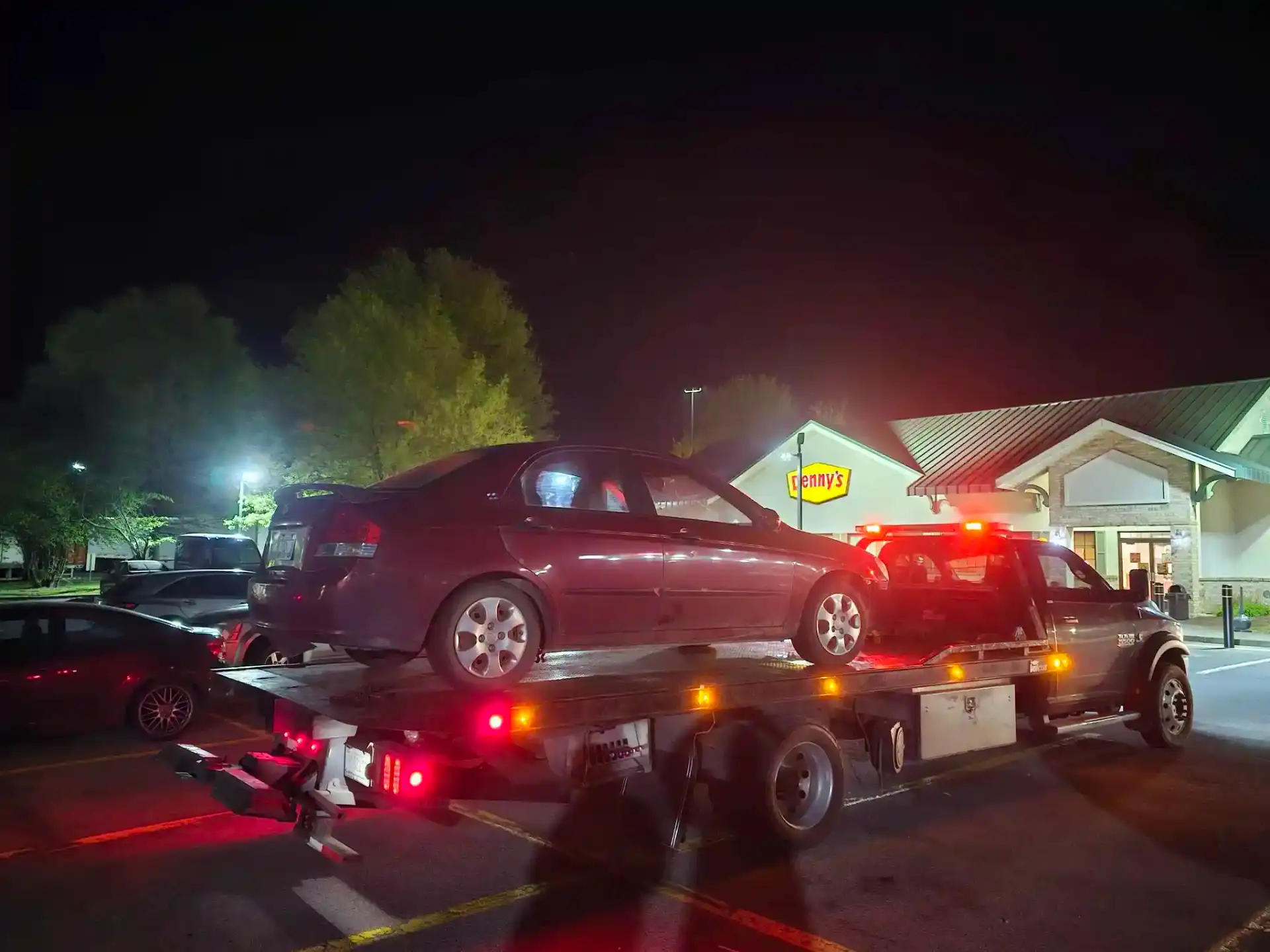
Hook Em' Up Towing dispatches a flatbed to overheated vehicles 24/7 across Nashville and the surrounding ZIPs. Flatbed is the right call here — wheel-lift towing keeps the drivetrain spinning, which adds heat to a system that's already failing. Request a Nashville flatbed tow so all four wheels stay off the ground until the engine is safely at the shop.
The Short Answer
Watch the temp gauge. Pull over at the first move above the middle mark. Turn off A/C, turn heater to full, get to a safe shoulder, idle 60 seconds, shut down. Don't open the radiator cap hot. Don't pour cold water on it. If you see a leak, swollen hoses, or steam, don't restart — call for a flatbed.
Hook Em' Up Towing covers all of Nashville and the surrounding ZIP codes. Call (615) 756-5330 and we'll have a flatbed out in 30–45 minutes.
Stranded or Stuck? We're Ready.
Our dispatchers are standing by around the clock — one call and a truck is on the way