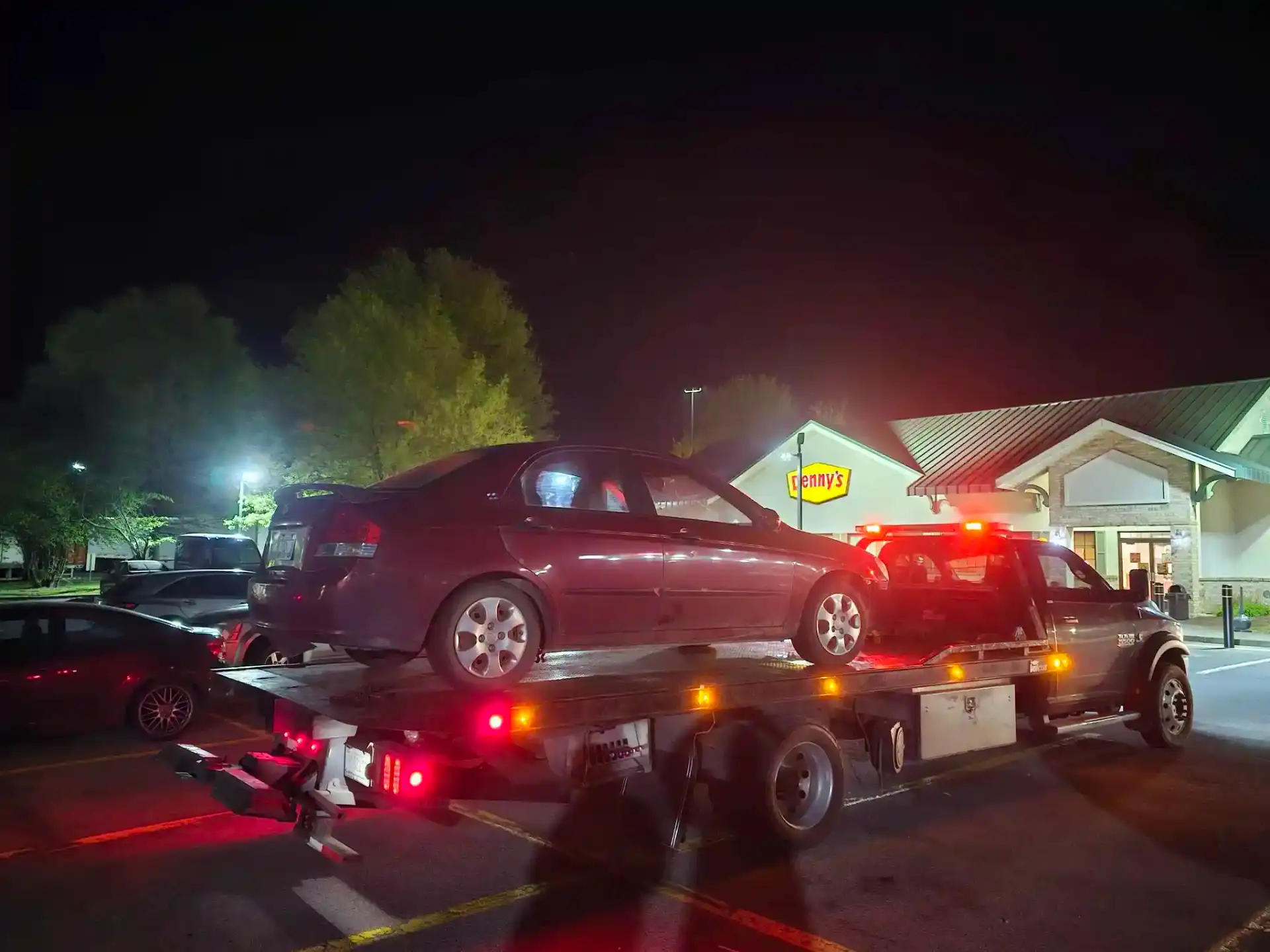
Page image supporting Car Broke Down in Nashville? Here’s What to Do. Car broke down in Nashville? Follow these 6 safety steps, know when to call a tow, a…
A Step-by-Step Plan for Your First Nashville Breakdown
Car broke down in Nashville? Follow these 6 safety steps, know when to call a tow, and get 24/7 help from Hook Em' Up Towing — fast response guaranteed.
I’ve seen it a thousand times over the last ten years from the cab of my truck or over the dispatcher line. The flash of hazard lights on the shoulder of I-24, a car sitting dead in a Donelson driveway, or the dreaded stall right in the middle of traffic on Charlotte Pike. Your car just quit on you. The engine sputtered, a weird light popped up on the dash, and now you’re stuck, listening to the hum of other cars flying past. Take a breath. This isn't your first crisis, and it certainly isn't mine. Here’s exactly what you need to do, based on a decade of helping folks get through this exact moment.
First Priority: Get to a Safe Spot
Before you even think about popping the hood, your only job is to make sure you and your car aren't a hazard. Getting hit by another vehicle is a real, serious risk, especially on Nashville's interstates.
If You're on a Highway (I-40, I-65, I-24, Briley Pkwy)
Get as far onto the shoulder as you can. The more space between you and the travel lanes, the better. Turn on your hazard lights immediately. This is the universal signal for "I have a problem."
Now, here’s the most important advice I can give you: stay inside your vehicle. I know you want to get out and assess the situation, but your car is a steel cage with airbags and crumple zones designed to protect you. The shoulder of I-40 is not. If you absolutely must exit the vehicle—for example, if you smell smoke—do it from the passenger side, away from the blur of traffic. Keep your seatbelt on while you wait.
A quick note on Nashville highway help: TDOT operates HELP trucks that patrol the major interstates during commute hours. They can change a tire, provide a little fuel, and push you to a safer spot, all free of charge. If it's rush hour, they might even get to you before we can.
If You're on a City Street or in a Parking Lot
You have a bit more breathing room here. If you break down on a street like West End Avenue or Nolensville Pike, try to coast into a turn lane, a side street, or a business parking lot. Put your hazards on. In these situations, it’s generally safe to get out of your car, as long as you remain aware of your surroundings.
However, if you're stuck in a travel lane on a busy downtown street like Broadway, the rules change back to highway mode. Stay in your car with your hazards on and call 911. MNPD can direct traffic around you until a tow truck arrives. It’s chaotic, but it’s the safest way to handle it.
What Am I Dealing With? A Quick Triage
Once you’re safe, a quick diagnosis helps you communicate clearly when you call for help. You don't need to be a mechanic, but these clues tell us a lot.
- Did the temperature gauge shoot into the red? That's an overheating engine. Do NOT open the radiator cap. Super-heated coolant will cause serious burns. Turn the engine off and let it cool down entirely.
- Did everything just die at once? If the radio, lights, and dashboard went dark simultaneously, it's almost always an electrical issue. This points to a dead battery or a failed alternator. A jump-start might work, but if the alternator is bad, the car will just die again a few minutes later.
- Is there a puddle forming underneath? Look at the color. Green or orange is coolant. Dark brown/black is engine oil. Reddish-pink is transmission fluid. Any of these mean you shouldn't try to drive the vehicle. A small puddle of clear water is likely just condensation from your A/C, which is perfectly normal.
- Did the engine just sputter and stop? No loud noises, no overheating, it just quit. This could be anything from a bad fuel pump to a sensor failure. This is classic "get it to the shop" territory.
Don't feel pressured to figure it out yourself. Your job is to be safe and get help on the way. Our job is to handle the car.
Making the Call for Help
When you need assistance, there's a correct order of operations.
- If anyone is hurt, you feel unsafe, or you're blocking a major artery, call 911 first. A car can be replaced; you can't.
- For the vehicle itself, call a professional. Our direct line is (615) 756-5330. When you call us, you get a real person on the line, day or night—not a call center or an answering service that passes your info along after a delay. That's a huge deal at 2 AM when you're stranded in an unfamiliar neighborhood like Antioch or Hermitage.
- Let someone know. Text a family member or friend your location and what’s going on. If your phone battery is low, do this immediately.
When you call, give us three pieces of information:
- Your exact location: The street and nearest cross-street, a mile marker on the highway, or a business name you're in front of.
- Your vehicle: The make, model, and color. "A silver Honda Accord" is perfect.
- The problem: What you observed from the triage checklist above. "My car overheated," or "I have a flat tire," or "It just won't start."
Is This a Quick Fix or a Full Tow?
Not every call ends with your car on the back of my truck. Many issues can be resolved right on the spot. We call this roadside assistance, and it’s faster and cheaper than a tow.
You Might Just Need a Roadside Fix
A significant chunk of our calls are for simple problems. You likely just need a service call if:
- Your car is completely dead (needs a jump-start).
- You have a flat tire and a usable spare.
- You ran out of gas.
- You locked your keys in the car.
These are usually 15-30 minute fixes that get you back on your way without needing a trip to the mechanic.
You Definitely Need a Tow
Don't risk more damage by trying to "limp it home." You need a tow if:
- The engine won't start even after a jump.
- There's a significant pool of oil, coolant, or transmission fluid.
- You hear loud grinding, clunking, or knocking sounds from the engine.
- The car overheated badly and won't cool down.
- You were in an accident, especially if the airbags deployed.
- The steering feels loose or the wheels look crooked after hitting a curb.
Trying to drive a seriously damaged car is how a $400 repair turns into a $4,000 engine replacement. It's not worth it. For anything involving major mechanical failure or an accident, a flatbed tow is the safest bet to prevent further damage.
What to Do While You Wait
You’ve made the call, and I’m on my way. You’ve probably got 20-45 minutes depending on traffic and your location. Use this time wisely.
- Gather Your Essentials: If the car is being towed, you won't see it again until it's at the shop. Grab your phone, charger, wallet, purse, house keys, and any medications.
- Decide Where It's Going: We'll need the name and address of your repair shop. If you don't have a regular mechanic, ask us. We know which shops in Nashville are trustworthy and which ones to avoid.
- Protect Your Phone Battery: Especially at night, your phone is your lifeline. Dim the screen, close background apps, and resist the urge to scroll social media.
- Stay Alert: When my truck arrives, you'll see the flashing amber lights. I’ll typically call your phone when I'm pulling up so you know it’s me. Be wary of unsolicited tow trucks that just show up. This is a known scam. If you didn't call them, send them away.
The Special Case: An Accident Scene
If your breakdown is the result of a collision, the situation is more complicated. The steps are different and more urgent.
- Safety First: Check for injuries. If anyone is even possibly hurt, call 911 immediately. Turn on hazards and move vehicles to the shoulder only if it is safe and they are drivable.
- Document Everything: Use your phone to take pictures of everything—the damage to all cars from multiple angles, the other driver's license plate, their driver's license and insurance card, the road conditions, and any skid marks. Do not skip this.
- Exchange Information, Not Blame: Get the other driver’s name, address, phone number, and insurance information. Provide yours. Do not apologize or admit fault. Just state the facts. Let the insurance companies sort out liability.
After an accident, towing is almost always necessary if there's any visible body damage, fluid leaks, or if airbags deployed. A modern car's systems are interconnected; a fender bender can easily hide damage to sensors, wiring, or cooling systems. Using a flatbed-towing service is critical for accident vehicles, particularly all-wheel-drive models, to avoid causing drivetrain damage during transport.
After the Truck Leaves
Once your car is safely loaded and on its way to the shop, your part in the immediate crisis is over. Get a receipt from the driver for the tow—you’ll need it for your insurance claim. Confirm the drop-off location and make sure the shop has a key or a plan to get one.
A breakdown is more than an inconvenience; it’s a message from your car. Once the dust settles, listen to what it was trying to tell you. Was the oil low? Had that "check engine" light been on for a month? Staying on top of maintenance is the best way to avoid seeing my flashing lights in your rearview mirror.
That feeling of watching yellow strobes pull up behind you on a dark, lonely road is a unique kind of relief. Having a plan for what to do before those lights arrive is what gets you to that moment safely.
Stranded or Stuck? We're Ready.
Our dispatchers are standing by around the clock — one call and a truck is on the way