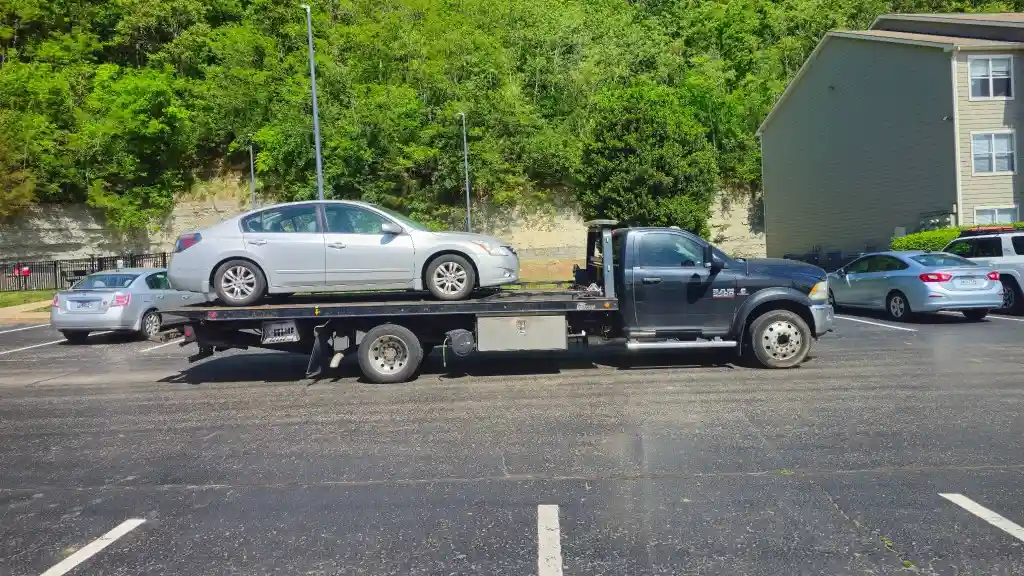
What Goes Into a Nashville Tow Bill — Line by Line
An honest breakdown of what hook-up fees, per-mile rates, and after-hours surcharges actually cost in Nashville — and the pricing red flags to watch for.
Towing Tips • November 5, 2025 • Hook Em' Up Towing Team
The pricing question is the one we get more than any other, and I get it. Nobody calls a tow truck on a good day. You're already annoyed, you're probably late for something, and now you're trying to figure out if the number you're being quoted is fair or if you're about to get worked over.
So instead of dancing around it, here's how we actually price work at Hook Em' Up Towing, what changes the number, and how to spot a quote that's about to grow legs.
What a normal tow costs in Nashville
For a regular passenger car going somewhere local — your office to a shop five miles down the road, your driveway to the dealership across town — you're usually looking at $90 to $150 all in.
That number is built out of two parts: the hook-up (which covers the driver showing up, looking your car over, and getting it on the truck the right way) and the per-mile after that. The hook is typically $75 to $125 depending on the truck we're sending. The per-mile is usually $3 to $7. Ten miles puts you somewhere around $120 to $195. Twenty starts pushing $180 to $300.
We always quote a total before the truck rolls. If a company won't give you a number on the phone, that's the warning sign — not the number itself.
What actually moves the price
A few things genuinely change what a job costs, and a few things shouldn't but sometimes do.
The car itself matters more than people expect. A Civic and a lowered C8 Corvette both have four wheels, but one of them takes me 10 minutes and one of them takes me 35 minutes, three planks of wood, and a lot of swearing. Lowered cars, exotics, and anything with custom suspension typically run 25 to 50 percent more because the work is genuinely harder and the consequences of doing it wrong are expensive. Motorcycles, oddly enough, are usually a little cheaper than a full-size sedan because the equipment is lighter and the job is faster.
Time of day matters less than you'd think. Yes, 2 AM Saturday usually has a small surcharge — maybe $20 to $50 — because we're paying our drivers to be awake at 2 AM Saturday. That's not a scam, that's payroll. But it shouldn't double your bill. If somebody's quoting you $300 for what would've been a $130 daytime tow because "it's after hours," that's not a surcharge, that's a markup with a polite name on it.
Distance is the big one. A cross-town tow inside the loop is one conversation. A tow out to Murfreesboro, Clarksville, or Lebanon is a different one, and we'll usually negotiate a flat number for those because the per-mile math gets ugly fast. Just ask up front.
Tolls, storage, and "labor" lines should always be discussed before, not after.
Roadside calls are usually cheaper than a tow
A solid chunk of our calls — somewhere around 4 in 10 — never involve actually moving the car. You called us thinking you needed a tow, and it turned out you needed a jump or a tire swap. That's a much smaller bill, and we're not going to upsell you to a tow you don't need. Bad reviews ruin a small operation faster than anything.
A jump start is usually $60 to $100. We come out, test the battery, and tell you straight whether it's just dead or whether it's fully cooked and going to leave you stranded again next week. Lockouts run $50 to $125 — newer cars with smart keys are on the higher end because the entry tools are more involved and the consequences of scratching anything are more expensive. A flat tire change is $75 to $125, and yes, we torque the lugs to spec instead of guessing. Out of gas is $80 to $125 with a couple of gallons to get you to a station, and no, we don't make you feel bad about it. We've done it ourselves.
How to keep from overpaying
Three things, in order of how much money they save you.
First, check what you already have. A surprising number of people are paying for roadside coverage they didn't know they had — through their car insurance, through a credit card, through their car's manufacturer for the first few years. Look at your insurance declarations page. If you're paying a few bucks a month for a "roadside" rider, you might already be covered up to a certain dollar amount per call. That's free to use.
Second, call a local company directly. National 800-number "towing networks" are middlemen. They take your call, mark it up, and sub the work out to a local operator like us — except now there's an extra cut taken off the top, and the local guy is being told to drive farther for less. That math gets passed back to you in the form of a higher quote, slower response, or both.
Third — and this is the one nobody does — get the total before the truck moves. Not "starts at." Not "around." A real number, including any after-hours, mileage, and fees. We quote that on the phone. Anybody who can't or won't is leaving themselves room to negotiate at the scene, and the leverage at the scene is not on your side.
Quotes that should make you nervous
A quote that's way under the market is almost always missing something. If somebody's offering you a $45 tow in Nashville, ask what the hook-up fee is, when mileage starts, and whether there's a fuel or after-hours line. Often the actual bill ends up north of $150 once everything's added on at the truck.
Vague language is the other tell. "Starts at," "as low as," "depends on the situation" — those aren't quotes, they're conversation starters. Push for a real total. If they can't give one because they "have to see the car first," ask what would have to be true for the price to change. A reasonable answer is "if it's stuck in mud, that's a winch fee of $X." An unreasonable answer is silence.
Save your quote. Screenshot the text, take a picture of the email, write down the name of who you talked to and what time. If the bill at the truck doesn't match, you've got documentation. Tennessee's consumer protection statutes do cover deceptive pricing, and the TMVC takes towing complaints seriously when they're documented.
A reasonable expectation for Nashville
For most people, in most situations, a normal local tow inside Nashville should land between $85 and $175. If you're being quoted way over that range, ask why. If you're being quoted way under it, ask what's not in the number.
Our tow truck types breakdown goes through what equipment matches what kind of job, which makes it easier to know whether the truck being sent actually fits the work. And if you're trying to decide between roadside and a full tow, the post-breakdown walkthrough covers when each one actually saves you money.
We've been doing this work in Nashville since 2010. The approach hasn't changed: tell you the number first, show up, treat the car like it's ours, and charge you exactly what we said we would.
If you want a real number for what's going on right now, before you commit to anything, call us at (615) 756-5330. We'll quote it before the truck rolls.
You can also see our transparent flatbed pricing — no surprise hookup fees stacked on at the scene. Modified or slammed? Read why lowered cars need zero-angle loading before you book. New here? Start at Hook Em' Up Towing for the full service list.
Questions About Your Situation?
Get a straight answer and an honest quote from a locally owned Nashville company
Call Now: (615) 756-5330