How to Compare Nashville Tow Trucks: Avoid Scams Guide
Comparison checklist for Nashville tow trucks. Questions to ask, red flags to spot, and how to verify legitimacy before you call.
When your car dies on the side of the road, the instinct is to grab your phone and call the first company that pops up. That urgency is exactly what predatory operators count on. This guide gives you a systematic approach to evaluating towing companies — before you're stranded — so you can make informed decisions under pressure.
How the Towing Industry Works
Let's be honest: towing has an image problem for good reason. The industry includes both consummate professionals and outright scammers, often operating in the same zip code. Understanding the business model helps you identify which is which.
Legitimate towing companies make money through:
- Volume of calls at fair prices
- Contracts with insurance companies and municipalities
- Roadside assistance partnerships (AAA, manufacturer programs)
- Repeat business and referrals
Predatory operators make money through:
- Bait-and-switch pricing
- Excessive "storage fees" at their lots
- Insurance fraud schemes
- Preying on stranded drivers' desperation
Knowing the difference before you need a tow is the entire point of this guide.
Five-Point Verification System
When evaluating any towing company, verify these five factors:
1. Tennessee Licensing — Tennessee Motor Vehicle Commission (TMVC) regulates towing operators. Legitimate companies have a TMVC license number (you can verify online), a city/county business license, and required signage on trucks displaying rates. Red flag: Companies that can't or won't provide license numbers. Ask for the TMVC license number and verify at the state website — it takes two minutes.
2. Insurance Coverage — Towing companies should carry commercial auto liability ($500,000-$1M minimum), on-hook/cargo insurance (covers your car while being towed), and garage keepers liability (covers your car while stored). Red flag: "We're fully insured" without specifics. Ask for a certificate of insurance. Legitimate companies provide these routinely for commercial clients.
3. Real Reviews From Real Customers — Google reviews are useful but require critical reading. Signs of authentic reviews include specific details (driver names, locations, situations), a mix of ratings (4.8 stars is more believable than 5.0), responses from the business to negative reviews, review dates spread over time, and reviewers with other review history. Signs of fake reviews include generic praise ("Great service! Fast!"), many 5-star reviews in a short timeframe, reviewers with only one review ever, and copy-paste language across reviews. Also check Yelp, BBB, and the company's Facebook page.
4. Upfront Pricing Practices — Professional towing companies have clear rate structures. Typical local towing costs in 2026: hook-up/base fee $85-$150, per-mile charge $3-$6 after included mileage, flatbed premium $25-$50 over wheel-lift, and after-hours surcharge $25-$50. Red flag pricing behaviors include refusing to quote prices over the phone, quoting dramatically low prices (bait-and-switch), adding fees at the scene that weren't disclosed, and requiring cash only. Ask specifically: "What is the total cost to tow my vehicle from here to my destination, including all fees?" Get this in writing via text if possible.
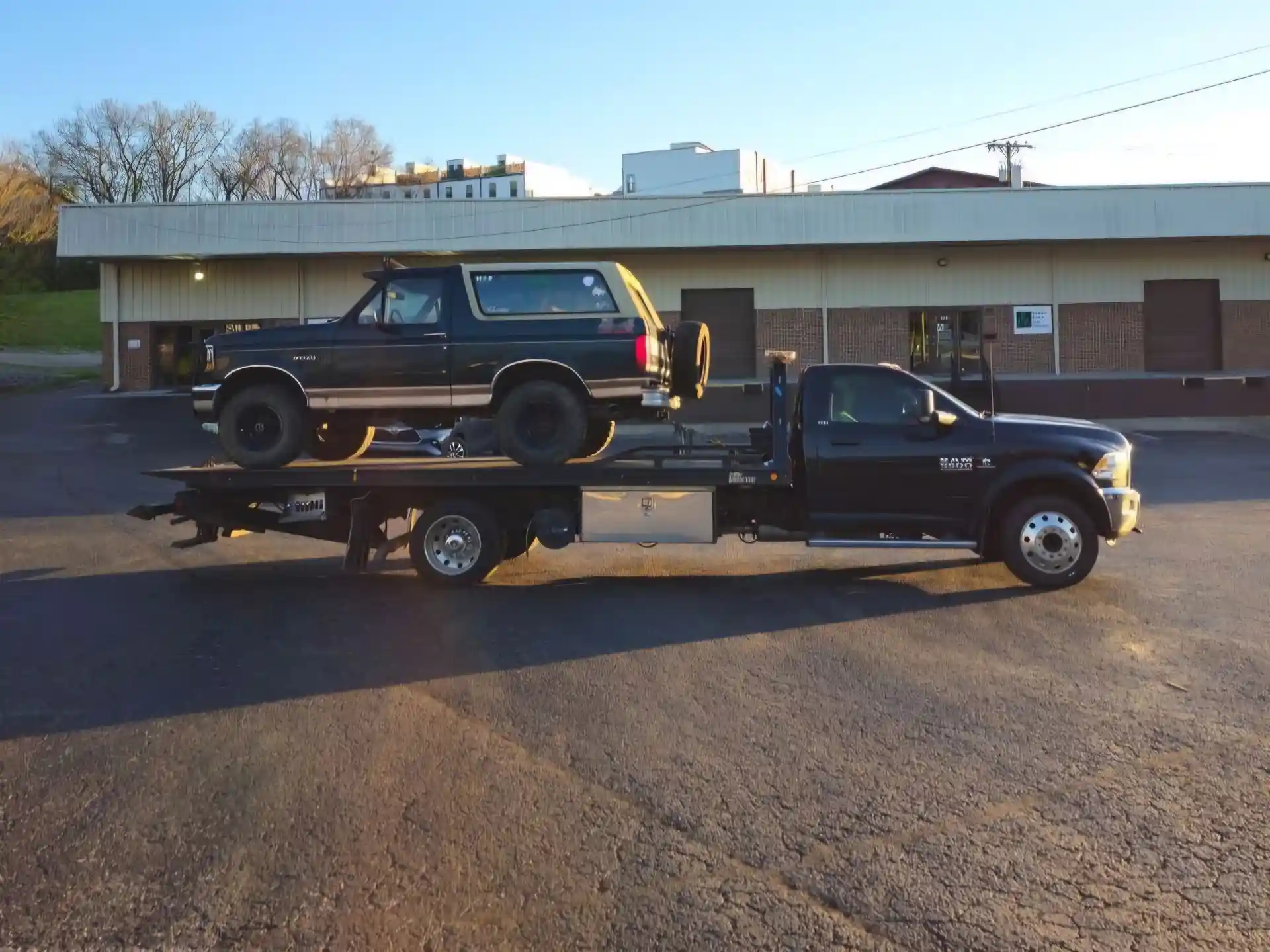
5. Equipment Appropriateness — Not all tow trucks are equal. Flatbed trucks load the entire vehicle on a flat platform and are required for all-wheel drive vehicles, luxury/sports cars, vehicles with body damage, and low ground clearance vehicles. Wheel-lift trucks raise one end and work for front-wheel drive vehicles (rear lifted) and rear-wheel drive vehicles (front lifted). Hook-and-chain trucks use old technology that damages vehicles — avoid for anything you care about. Always ask: "What type of truck are you sending for my vehicle?"
Scam Tactics and How to Counter Them
The Scanner Chase — Some operators monitor police scanners and show up at accident scenes unrequested. They'll pressure you to sign while you're still in shock. Your response: "I'm calling my own towing company." You have this right. Police cannot require you to use a specific tower unless your vehicle is blocking traffic and you haven't arranged removal.
The Low-Ball Quote — "We'll tow you for $50!" Then when they arrive: "Oh, your car needs a flatbed, that's extra. And there's a highway fee. And administrative costs." Your response: Get total price in writing before they dispatch. If the final bill differs from the quote, document everything and file complaints.
The Hostage Vehicle — Your car gets towed to their lot. Now they demand excessive storage fees before releasing it, sometimes accumulating hundreds per day. Your prevention: Specify destination before towing begins. Never let them take your car to an unspecified location. Tennessee law requires storage facilities to provide written authorization forms — review before signing.
The Kickback Referral — A tow driver offers to take your car to "their guy" for repairs. That shop pays the driver referral fees, which get built into your repair bill. Your response: Always choose your own repair facility. If you don't have one, research first. Urgency is manufactured.
Emergency Preparedness Checklist
Don't wait for a breakdown to find a towing company. Build your contact list now:
- Research 2-3 towing companies in your area and verify licensing and insurance
- Note their hours and service area, then save numbers in your phone
- Write one number on a card in your glove box
- Check your auto insurance policy for roadside assistance coverage, towing reimbursement limits, and preferred provider networks
- Know your AAA or manufacturer benefits — towing distances vary by membership level, and many new cars include roadside assistance
- Check premium credit card benefits, as some include complimentary towing
When you're actually stranded — immediate safety: Get off the roadway if possible, turn on hazard lights, set out flares or triangles if you have them, and stay in the vehicle if on a highway.
Making the call: Note your exact location (cross streets, mile markers, landmarks), know your vehicle's year, make, model, and drivetrain, assess whether it can roll, steer, or shift, and decide your destination before calling.
On the phone: Describe your location precisely, describe the vehicle and its condition, ask for the total price to your destination, get the estimated arrival time, and get the driver name and truck number if possible.
When the tow truck arrives: Verify the company name matches who you called, confirm the price before loading, watch the loading process and take photos if concerned, get a receipt with itemized charges, and keep all documentation.
Questions to Ask Any Towing Company
Use these questions when researching or when calling in an emergency:
- "What is your TMVC license number?"
- "What's the total cost including all fees to tow my vehicle to this location?"
- "What type of truck are you sending?"
- "What's your estimated arrival time?"
- "Do you accept credit cards?"
- "Is your driver an employee or independent contractor?"
Legitimate companies answer these without hesitation. Evasiveness is information.
Finding a trustworthy towing company isn't about luck — it's about verification. The predatory operators count on your desperation preventing due diligence. By understanding licensing requirements, pricing norms, equipment needs, and common scams, you turn the tables. Build your contact list now, know your coverage, and save this guide. When you're stranded at midnight on an unfamiliar road, you'll be glad you prepared.
After any towing experience — good or bad — leave an honest review. You'll help the next stranded driver make a better decision.
Hook Em' Up — Nashville's Trusted Choice
Locally owned since 2010, serving every Nashville neighborhood with fast, fair service