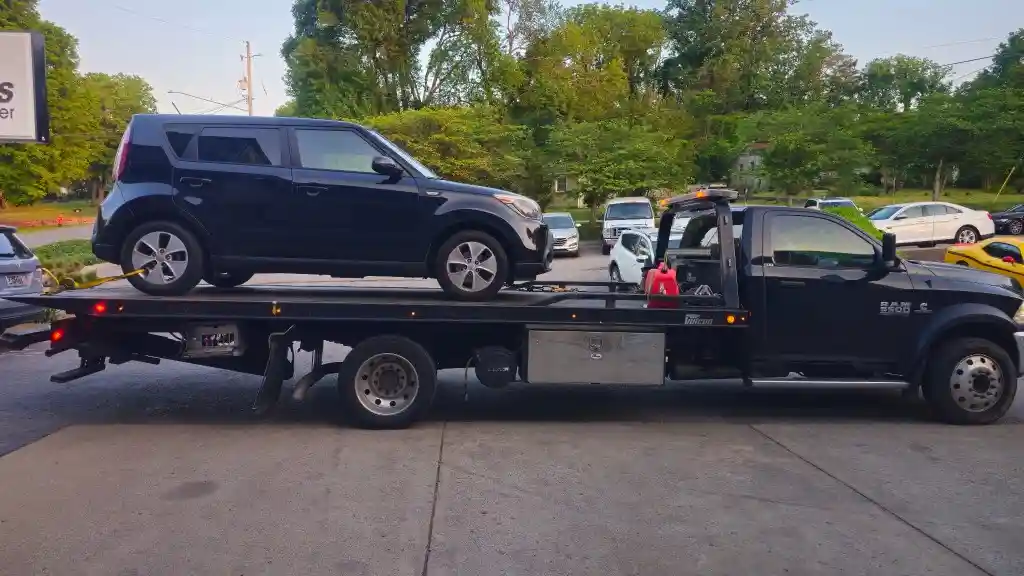
Why SUVs Need Flatbed Towing: AWD Drivetrain Protection
Learn why towing an SUV wrong destroys AWD systems. Technical guide to drivetrain protection, transfer cases, and safe transport methods.
Understanding why your SUV requires specific towing methods isn't just industry jargon—it's essential knowledge that can save you thousands of dollars in repairs. Modern SUVs are engineering marvels with complex drivetrains that don't tolerate improper handling. This guide explains the technical reasons behind flatbed towing requirements and how to protect your investment.
The Engineering Behind AWD Systems
How All-Wheel Drive Works
To understand why towing matters, you first need to understand what's under your SUV:
Permanent AWD systems distribute power continuously to all four wheels through a center differential and transfer case. When the vehicle moves—even being towed—these components engage and rotate. Without the engine running to provide lubrication, the internal gears and bearings experience friction damage within just a few miles.
On-demand AWD systems (like those in many crossovers) use electronic clutches that can unexpectedly engage when wheels rotate. This happens because the computer detects speed differences between axles and "corrects" the problem—by destroying the clutch pack.
Part-time 4WD systems (common in trucks and body-on-frame SUVs) should theoretically be safe in 2WD mode, but the driveshaft is still connected. One bump, one jolt, and you've got binding in the transfer case.
Transfer Case: The Expensive Component
The transfer case is the heart of any AWD or 4WD system. It splits power between front and rear axles and contains:
- Planetary gear sets ($800-1,500 for parts alone)
- Chain drives ($400-800)
- Viscous couplings or electronic clutches ($600-1,200)
- Multiple bearings and seals ($200-500)
Labor to replace a transfer case: $400-900
Total damage from improper towing: $2,500-$10,000+
That's not a typo. We've seen repair bills from dealerships that rival the cost of a used car—all because someone used a wheel-lift truck.
Why Transmission Fluid Matters
Here's something most people don't know: automatic transmissions rely on their internal pumps to circulate fluid. Those pumps only work when the engine is running.
When an AWD vehicle is towed with wheels on the ground:
- The wheels spin the axles
- The axles spin the differential
- The differential connects to the transmission output shaft
- The output shaft spins internal components—without lubrication
After 10-15 miles: Bearing surfaces begin scoring After 20-30 miles: Internal clutch packs overheat After 50+ miles: Catastrophic transmission failure
Transmission replacement cost: $4,000-$8,000
This is why your owner's manual specifically states "flatbed only" for AWD models.
Specific SUV Models and Their Vulnerabilities
Toyota Highlander
The Highlander's Electronic On-Demand AWD uses an electronically controlled coupling that modulates torque to the rear axle. The rear differential contains this coupling, and when the wheels rotate without the engine controlling the system, the coupling doesn't disengage properly.
Risk level if wheel-lift towed: High—rear differential damage likely within 5 miles
Honda Pilot / CR-V
Honda's i-VTM4 (Intelligent Variable Torque Management) and Real-Time AWD systems use rear-mounted clutch packs controlled by the vehicle's computer. During normal driving, the system constantly adjusts. During towing, there's no adjustment happening—just mechanical wear.
Particular vulnerability: The CVT transmission in newer models is extremely sensitive to overheating
Chevrolet Tahoe / Suburban
Full-size GM SUVs with 4WD use a traditional transfer case with a two-speed range and shift-on-the-fly capability. While you can shift to 2WD, the front driveshaft remains connected to the transfer case output.
The catch: Even in 2WD, the front differential internals rotate when the front wheels turn. No lubrication = damage.
Ford Explorer / Expedition
Ford's Intelligent AWD system is sophisticated but vulnerable. The rear drive unit contains an electronically controlled clutch pack that's designed to handle power, not being dragged down the road.
Added concern: The independent rear suspension geometry changes under towing load, potentially causing CV joint stress
Jeep Grand Cherokee / Wagoneer
Jeep's Quadra-Drive II is one of the most capable AWD systems on the market—and one of the most expensive to repair. The electronic limited-slip differentials (eLSD) in front and rear, combined with the two-speed transfer case, mean you have four expensive components at risk.
Repair bill for Quadra-Drive II damage: $5,000-$12,000
The Weight Factor
Beyond drivetrain concerns, SUVs present physical challenges:
Average vehicle weights:
- Compact crossover (RAV4, CR-V): 3,400-3,800 lbs
- Midsize SUV (Highlander, Pilot): 4,200-4,600 lbs
- Full-size SUV (Tahoe, Expedition): 5,400-6,200 lbs
Why weight matters for towing:
A wheel-lift truck suspends roughly 40% of the vehicle weight from the lift mechanism. For a 5,500-lb Tahoe, that's 2,200 lbs hanging from two wheels. The stress on wheel bearings, suspension components, and the wheel-lift equipment itself approaches or exceeds safe limits.
Flatbed trucks distribute weight across the entire vehicle, eliminating point-load stress.
Ground Clearance and Low-Profile Designs
Modern SUVs are increasingly aerodynamic, meaning lower air dams, side skirts, and front bumper profiles. A traditional hook-and-chain or even wheel-lift approach can:
- Scrape or crack front bumper covers ($800-2,000 to replace)
- Damage air dam components ($400-800)
- Tear off plastic undertray panels ($200-600)
- Contact exhaust components during loading
Flatbed towing with a gradual approach angle eliminates these risks entirely.
Hybrid and Plug-In Hybrid SUV Considerations
Electrified SUVs add another layer of complexity:
Regenerative braking systems: When wheels rotate, electric motor-generators can produce electricity, potentially charging the battery in uncontrolled ways or damaging power electronics.
High-voltage battery safety: Most hybrid batteries are floor-mounted. Improper towing that affects ground clearance or impacts the undercarriage could damage battery housing.
Power electronics cooling: Some hybrid systems rely on driving to circulate coolant. Extended towing without proper precautions can lead to overheating.
Examples: Toyota Highlander Hybrid, Ford Explorer Hybrid, Jeep Grand Cherokee 4xe
All hybrid SUVs require flatbed towing—no exceptions.
How to Verify Your SUV's Towing Requirements
Check Your Owner's Manual
Every vehicle's towing instructions are documented. Look for:
- "Recreational Towing" section
- "Emergency Towing" section
- Diagrams showing approved tow points
- Warnings about flat towing or dolly use
Manufacturer Websites
Most manufacturers provide towing guides:
- Toyota: "Flat Towing Your Vehicle" guides by model year
- Honda: "Roadside Assistance Guidelines" PDFs
- Ford: "Towing a Disabled Vehicle" in owner's resources
- GM: "Trailering and Towing" specifications
VIN Lookup
Your VIN decodes to specific drivetrain configurations. Towing companies with proper training will verify drivetrain type before selecting equipment.
What Proper Flatbed Loading Looks Like
Understanding the correct process helps you identify professional service:
Step 1: Assessment The operator inspects your vehicle, notes drivetrain type, and selects appropriate equipment.
Step 2: Positioning The flatbed is lowered completely, creating a gradual ramp. Approach angle should be minimal.
Step 3: Attachment Winch cable connects to factory tow hooks (not control arms, not random suspension components). Most SUVs have front tow hook locations noted in the owner's manual.
Step 4: Loading Vehicle is pulled straight onto the bed. No side-loading, no dragging at angles.
Step 5: Securing Four-point wheel strap tie-downs at minimum. Straps go around tires, not through wheels. Tension is firm but not crushing.
Step 6: Transport Driver monitors load during transport. Safe speeds, gentle acceleration and braking.
Insurance and Warranty Implications
Your comprehensive auto insurance covers towing—but it may not cover damage caused by improper towing. Similarly, manufacturer warranties can be voided if mechanical damage results from towing methods that violated owner's manual instructions.
Document everything:
- Photos of vehicle before loading
- Photos of loading process
- Written confirmation of tow method
- Driver and company information
This documentation protects you if damage occurs.
Red Flags When Calling for Towing
Be cautious if a towing company:
- Says wheel-lift is "fine" for your AWD SUV
- Doesn't ask about your drivetrain type
- Quotes prices significantly below market rate
- Can't confirm flatbed availability
- Seems unfamiliar with your vehicle model
Good indicators:
- Asks specific questions about AWD/4WD configuration
- Confirms flatbed dispatch without hesitation
- Provides clear pricing upfront
- Has reviews mentioning SUV or AWD experience
Summary
Your SUV's drivetrain is a precision-engineered system that costs thousands to repair. The extra cost of flatbed towing (typically $50-75 more than wheel-lift) is trivial compared to the potential for catastrophic damage. Understanding the technical reasons—transfer case lubrication, transmission pump operation, weight distribution—gives you the knowledge to insist on proper service.
When you call for towing, specify flatbed. When the truck arrives, verify it's a flatbed. Don't accept substitutions or assurances that "it'll be fine." Your SUV's drivetrain is worth protecting.
Need Towing or Roadside Assistance?
Available 24/7 across Nashville for all your emergency towing needs