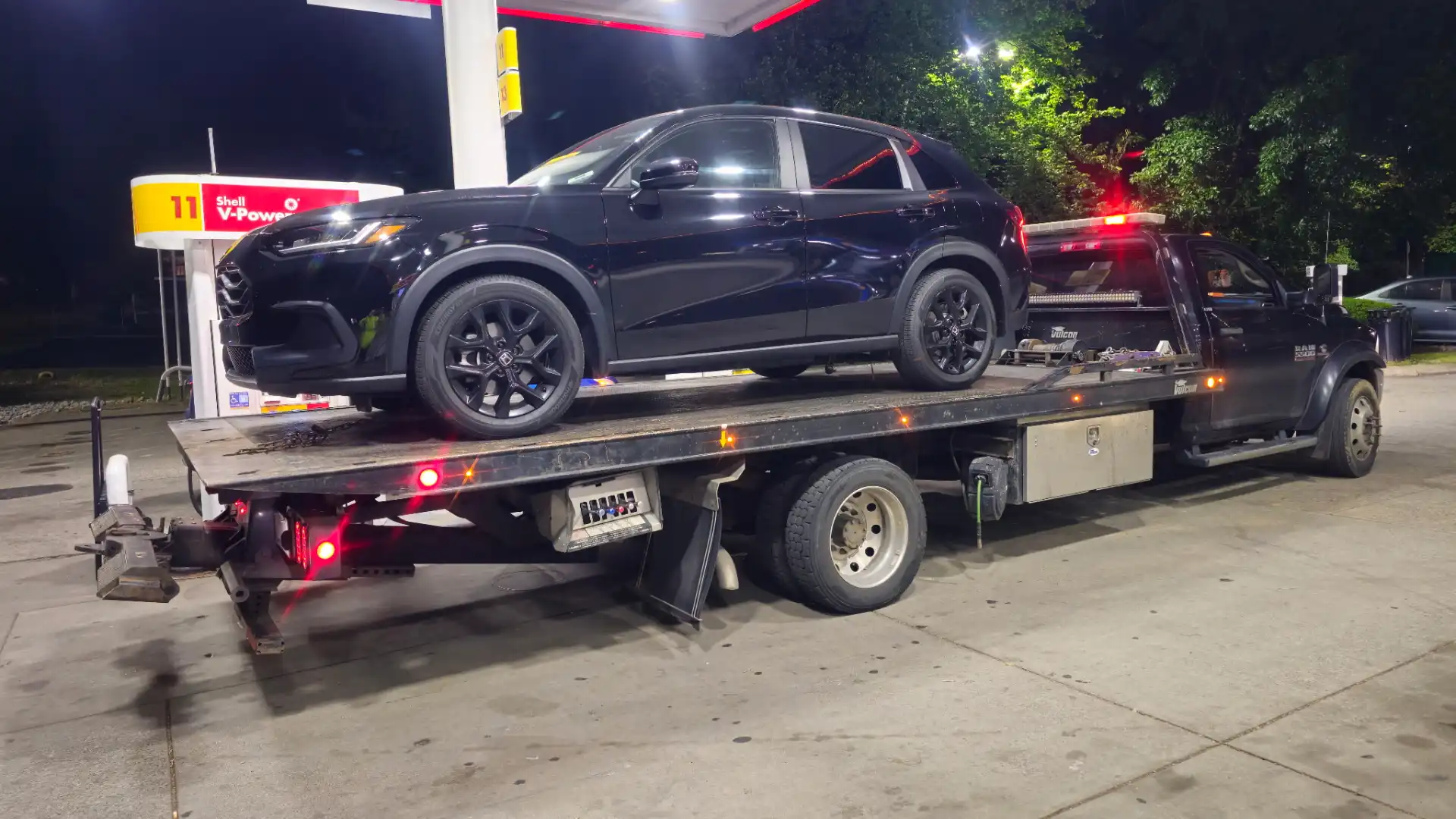
Page image supporting Why Electric Vehicles Must Be Towed on a Flatbed. The drivetrain reason every Tesla, Rivian, Mach-E, and Lightning manual says flatb…
Towing an EV the Wrong Way Can Cost You a Drivetrain
The drivetrain reason every Tesla, Rivian, Mach-E, and Lightning manual says flatbed only — regen braking, motor coupling, and 12V failure.
We've seen a huge increase in EV towing calls over the past few years. Teslas, Rivians, the Mach-E — they're all over Nashville now. And honestly, a lot of towing companies are still figuring out how to handle them properly. We made it a priority early on to learn the right way, because getting it wrong can cost an EV owner thousands.
Here's the thing most people don't realize: you can't tow an electric vehicle the same way you'd tow a regular car. The drivetrain is completely different, and what works fine on a gas-powered sedan will destroy an EV.
Why You Can't Just Hook Up an EV and Go
With a gas car, you can usually put the transmission in neutral and tow it with two wheels on the ground for short distances. EVs don't work that way. The electric motor is directly connected to the wheels — there's no traditional neutral gear that truly disconnects everything.
When the wheels spin on an EV, the motor spins too. That motor acts as a generator (that's how regenerative braking works), and it starts pushing electricity back into the battery system. The problem is, during a tow, nobody's controlling that process. The battery management system isn't expecting it, and the result can be overcharging, overheating, or damage to the power electronics.
I've talked to EV owners who had their cars towed on a wheel-lift by another company. Everything seemed fine at first, but a few weeks later they started getting error codes and noticed the battery wasn't holding charge like it used to. That kind of damage doesn't always show up immediately, which makes it worse — by the time you realize something's wrong, it's hard to prove what caused it.
Flatbed Is the Only Safe Option
Every EV manufacturer says the same thing: use a flatbed. Tesla, Rivian, Ford, Hyundai, GM — they all specify flatbed towing in their owner's manuals. There's no debate about this one.
When we load an EV onto our flatbed, all four wheels are completely off the ground. No spinning, no regenerative braking, no uncontrolled electricity going where it shouldn't. It's the only way to guarantee zero drivetrain damage.
What About "Transport Mode"?
Most EVs have a Transport Mode or Tow Mode you can activate through the touchscreen. A lot of people think this makes the car safe for wheel-lift towing. It doesn't.
Transport Mode releases the electronic parking brake and lets the wheels roll freely — that's it. It's designed so we can roll the car onto a flatbed. It does NOT disconnect the motor from the wheels, and it doesn't stop regenerative braking during road transport.
Think of it as "flatbed loading mode," not "tow me however you want mode."
How We Handle Specific EVs
Tesla (Model 3, Y, S, X)
We tow more Teslas than any other EV in Nashville. The process is pretty straightforward if you know what you're doing:
Activate Transport Mode through the touchscreen (Controls > Service > Towing). If the screen is dead — which happens more often than you'd think when the 12V battery dies — we use the front tow eye to winch it onto the flatbed. Model X owners need to make sure those falcon-wing doors are closed and locked before we load. And if you've got air suspension on the S or X, set it to Standard height first.
Rivian R1T and R1S
Same deal — flatbed only. Rivian's Transport Mode is in the center display. One nice thing about towing an R1T: we can use the truck bed to store personal items during transport if needed.
Ford Mach-E and F-150 Lightning
Ford is clear about this: flatbed only for all electric models. The Lightning is a heavy vehicle — over 6,500 lbs — so we make sure we're dispatching a flatbed rated for that weight. We also remind owners to turn off the Pro Power Onboard system before transport.
Chevy Bolt
GM recommends flatbed. They do mention that in a pinch, you can use front-wheel dollies with the rear wheels on the ground for very short distances, but we don't recommend it. Why risk it when we can just bring a flatbed?
Hyundai Ioniq 5 / Kia EV6
These are on the E-GMP platform. AWD versions absolutely require flatbed. The RWD versions technically can be towed with front wheels on the ground for short distances, but again — flatbed eliminates any risk.
Common Reasons EVs Break Down in Nashville
Running Out of Charge
This is more common than you'd expect. Nashville's hills eat through battery range faster than people anticipate, especially if you're running the AC full blast in July or the heater in January. Cold weather alone can reduce range by 20-40%.
We get calls from people who planned their route based on the range estimate at home, but between the hills, the weather, and an unexpected detour, they come up short. Doesn't help when your planned charging station is out of service when you get there.
The 12V Battery Problem
Here's something that surprises a lot of EV owners: your car still has a regular 12V battery, just like a gas car. It powers the door locks, lights, computer systems, and the touchscreen. When that little 12V battery dies, you can't unlock the doors, can't put the car in gear, can't do anything — even though you might have a fully charged main battery.
These 12V batteries last about 3-5 years, same as in a gas car. Get it tested at your annual service appointment.
Software Issues
Over-the-air updates occasionally cause problems. We've picked up cars where the touchscreen froze and the owner couldn't shift out of Park. Sometimes a hard reboot fixes it (on Teslas, hold the brake pedal and both scroll wheels on the steering wheel). Sometimes it doesn't, and you need a tow to the service center.
Flat Tires
EVs are heavier than comparable gas cars, which wears tires faster. The instant torque doesn't help either — it accelerates tread wear on the drive wheels. And here's the kicker: most EVs don't come with a spare tire. A flat means you're calling for a tow, period. The same drivetrain rules apply to gas-powered AWD vehicles — request our Nashville flatbed towing service so all four wheels stay off the ground.
What It Costs
We don't charge extra for electric vehicles. An EV flatbed tow uses the same rate card as any other flatbed job — the vehicle type doesn't change the service. If another company quotes you an "EV surcharge" or "specialized handling fee," push back or call someone else.
Before paying out of pocket, check your manufacturer's roadside program. Tesla covers flatbed towing for 4 years from purchase. Rivian includes 5 years. Hyundai and Kia bundle 5 years or 60,000 miles with their EV warranties. Ford's coverage on the Mach-E and Lightning runs 5 years. These programs dispatch a flatbed automatically — just call the number in your vehicle's companion app.
What to Do When Your EV Stops
Pull over safely, turn on your hazards, and conserve whatever battery you have left by turning off the climate system. Check your vehicle's companion app — most can diagnose error codes remotely and share your exact location.
When you call for a tow, tell the dispatcher you have an electric vehicle and need a flatbed. Give them the make, model, and year. Let them know if the car can roll freely or if it's locked up, and mention any error messages you're seeing. That information helps us bring the right equipment the first time.
Not every towing company in Nashville knows how to handle EVs properly. We do. We've invested the time to learn the procedures for every major EV on the road, and we carry the right equipment to handle them safely. Your EV is a significant investment — it deserves a towing company that treats it like one.
EV stuck or out of charge in Nashville? Give us a call at (615) 756-5330 and we'll get a flatbed to you fast. For Teslas, Rivians, and any electric drivetrain, only request an EV-safe flatbed pickup — never a wheel-lift hook.
Questions About Your Situation?
Get a straight answer and an honest quote from a locally owned Nashville company