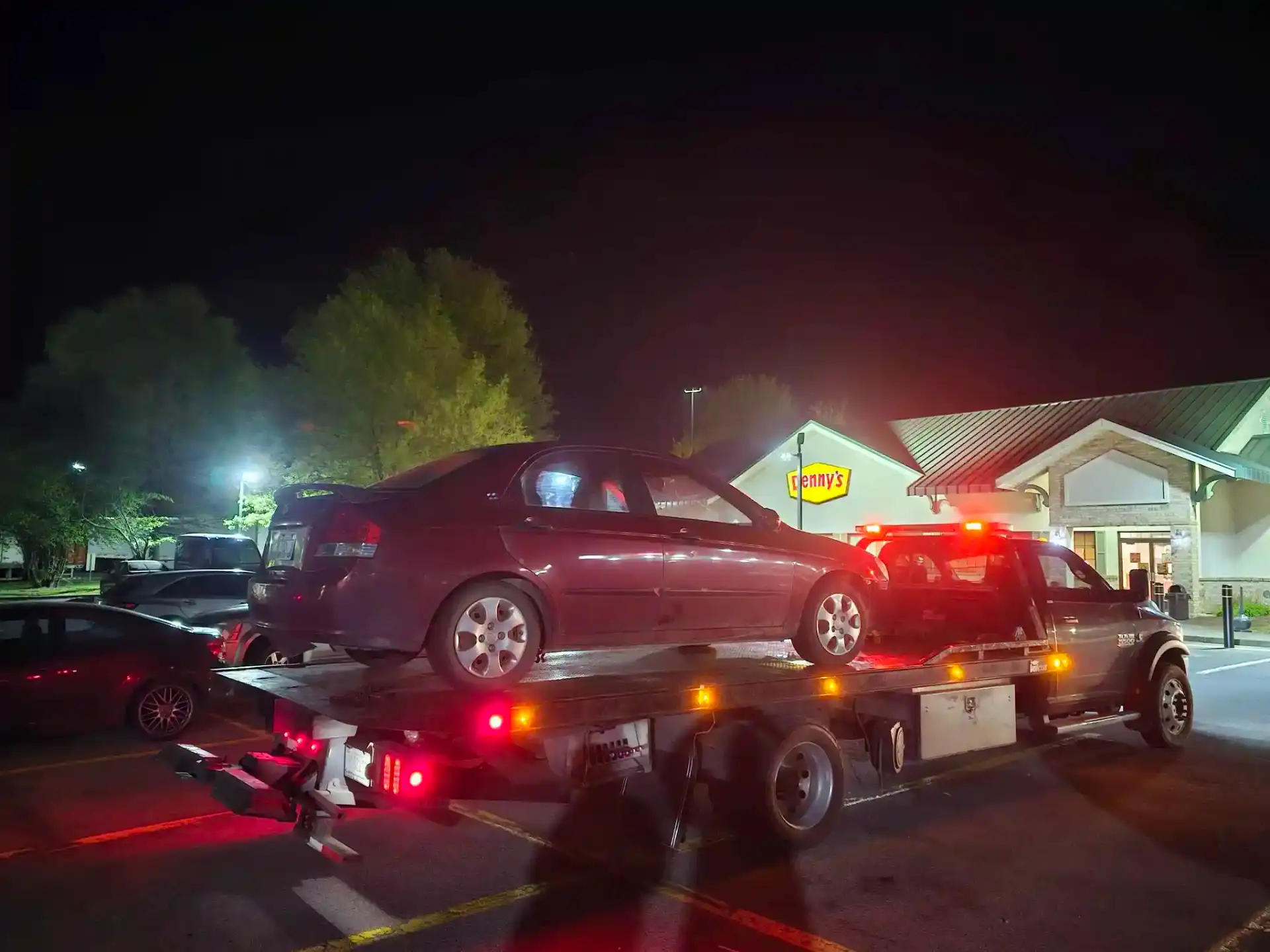
Page image supporting How to Tow a Lifted Truck — Nashville Operator’s Guide. Why standard wreckers can’t touch a lifted 4x4, what flatbeds actually fit,…
Towing a Lifted Truck in Nashville: Ramps, Clearance, and 4x4 Rules
Why standard wreckers can’t touch a lifted 4x4, what flatbeds actually fit, and the dispatch details a Nashville operator needs before the truck rolls.
Lifted trucks look tough until they need a tow. Then they become one of the trickiest jobs on our board. Wrong equipment and you either won't get the truck loaded at all, or you'll rip a control arm off trying. I've been called out to fix a bad tow more than once — usually after a national roadside dispatch sent a standard wheel-lift and the driver bailed after realizing his boom couldn't clear the lifted front end.
If you drive a lifted truck in Nashville, here's what you need to know before you call for a tow — and what to insist on when you do.
Why Lifted Trucks Break Standard Wreckers
A stock F-150 sits about 8 to 9 inches of ground clearance. A 6-inch lift on 35s puts that same truck at 14 to 15 inches, sometimes more. Now try to hook a wheel-lift wrecker under the front bumper: the boom arms need enough clearance to slide under the tires and cradle them from below. On a lifted truck, they often can't. The arms bottom out on the pavement before they reach the tires.
Even worse, the aftermarket bumper on a lifted truck is usually a heavy steel replacement — winch bumper, prerunner, or full plate. Those don't have factory-designed tow attachment points where a wrecker driver expects them. The stock frame hooks are still there, but they're now buried behind or under the bumper where a standard boom can't reach.
A flatbed with a proper approach ramp system is usually the only truck that can safely load a lifted 4x4. And even flatbeds have limits.
The Approach Angle Problem
Here's what most non-tow-truck-people don't realize: a flatbed's ramp angle is designed for cars sitting near stock ride height. When the bed tilts back and the ramps deploy, they create a slope somewhere between 12 and 18 degrees depending on the truck. A stock passenger car has a departure angle of 20+ degrees and clears the transition easily.
Now roll a lifted 4x4 with 35-inch tires onto that same ramp. The front bumper might clear, but as the rear axle transitions from ramp to bed, the truck pitches nose-up. If your aftermarket rear bumper hangs low, or if you have a lift with limited suspension droop, the rear bumper can catch on the pavement or the ramp edge. I've seen bent tailgates from this exact scenario.
The fix is either an extended-approach flatbed (some carriers have longer, gentler ramps), or manually walking the truck up on wheel skates one axle at a time while a driver spots the clearance. Either way, the operator has to know what they're dealing with before they roll out — which is why the dispatcher needs the truck year, make, model, and lift height on the phone.
What to Tell the Dispatcher
When you call, don't just say "I need a tow for my truck." Give them:
- Year, make, model, cab, and bed (e.g. 2019 Silverado 1500 crew cab, short bed)
- Lift height and type (e.g. 6-inch suspension lift, no body lift)
- Tire size (e.g. 35x12.50R20)
- Aftermarket bumpers (front and/or rear, steel or aluminum)
- Whether the drivetrain works (rolling in neutral vs. locked up)
That combination tells us whether we can flatbed it with our standard rig or need to send the extended-ramp truck. It also tells us whether we need to bring dollies or skates for the drive wheels if it's stuck in gear.
Four-Wheel-Drive Considerations
Almost every lifted truck in Nashville is 4x4. That adds another layer to the tow decision.
If your 4x4 has manual locking hubs (older Broncos, some diesel work trucks, custom builds), we can unlock the hubs and tow it with the front wheels rolling free — but only if the transfer case can be shifted to neutral. Modern electronic transfer cases usually can't unless the truck has 12-volt power.
If you don't know your truck's 4WD system, we'll ask on the phone. When in doubt, flatbed.
Off-Road Recovery for Lifted Trucks
The other common lifted-truck call: it's not broken down, it's stuck. Buried in mud at a jobsite off Nolensville Pike, sunk into a soft shoulder on Old Hickory Boulevard, high-centered on a rock at a hunting property. Regular tow trucks aren't set up for this. You need a truck with a winch, proper snatch straps and shackles, and a driver who understands recovery angles and how to avoid ripping the recovery point off the truck.
Winch-out and off-road recovery is a different service from towing. Same phone number, different truck. Tell the dispatcher what kind of situation you're in so they send the right one — showing up with a flatbed to a truck that's buried to the frame is a waste of everybody's time.
Nashville-Specific Notes
Bridge and overpass clearance. Some Nashville bridges have posted clearances at 13'6". A lifted truck on a flatbed can push 14 feet total height. We route around low bridges when the load requires it, but you should be aware if you're being taken across an unfamiliar area.
Diesel-specific issues. Most lifted trucks are diesel, and diesels have their own breakdown patterns — fuel starvation after long descents on I-24, DEF system faults that force limp mode, and dead batteries after long sits. If you drive a diesel, save our diesel breakdown guide — it covers the calls we see most often.
Fifth-wheel and gooseneck situations. If your lifted truck is hooked to a trailer when it breaks down, tell dispatch. We may need to unhook the trailer first and dispatch a second truck if the trailer is loaded. Trying to flatbed a truck-with-trailer is not a normal towing job.
The Lifted-Truck Bottom Line
A lifted truck needs a driver who's done it before, on a truck that can physically handle the load geometry. When you call (615) 756-5330, tell us up front what you drive. We'll match the equipment to the job on the first dispatch — not the third — and you won't be standing on the shoulder of I-40 watching a wrecker driver realize his boom won't fit.
Save the number before you need it. Lifted trucks break down in the middle of nowhere as often as they break down in town, and cell service on some of the backroads around Davidson County is spotty at best.
Hook Em' Up Towing — Nashville's Trusted Choice
Locally owned since 2010, serving every Nashville neighborhood with fast, fair service