Page image supporting How to Tow an AWD Vehicle Safely (Nashville Guide). How to tow an AWD vehicle without wrecking the transfer case: which trucks to us…
How to Tow an AWD Vehicle Safely Without Destroying the Drivetrain
How to tow an AWD vehicle without wrecking the transfer case: which trucks to use, which vehicles are most at risk, and what improper AWD towing actually costs.
If you drive an all-wheel-drive vehicle in Nashville — a Subaru, an Audi Quattro, a Tesla, a RAV4 AWD, a Q5, an X3 — and it ever breaks down, there is one question that decides whether your next repair bill is $150 or $9,000: how the tow truck picks it up. I've been driving and dispatching in Nashville for over a decade, and the worst calls I get aren't the wrecks. They're the customers who call three weeks after a tow: "My car started grinding after it was towed and the shop says I need a new transmission." That's a completely avoidable disaster, and this guide walks you through exactly how to tow an AWD vehicle safely so it never happens to you.
How to Tow an AWD Vehicle Safely: The Only Correct Method
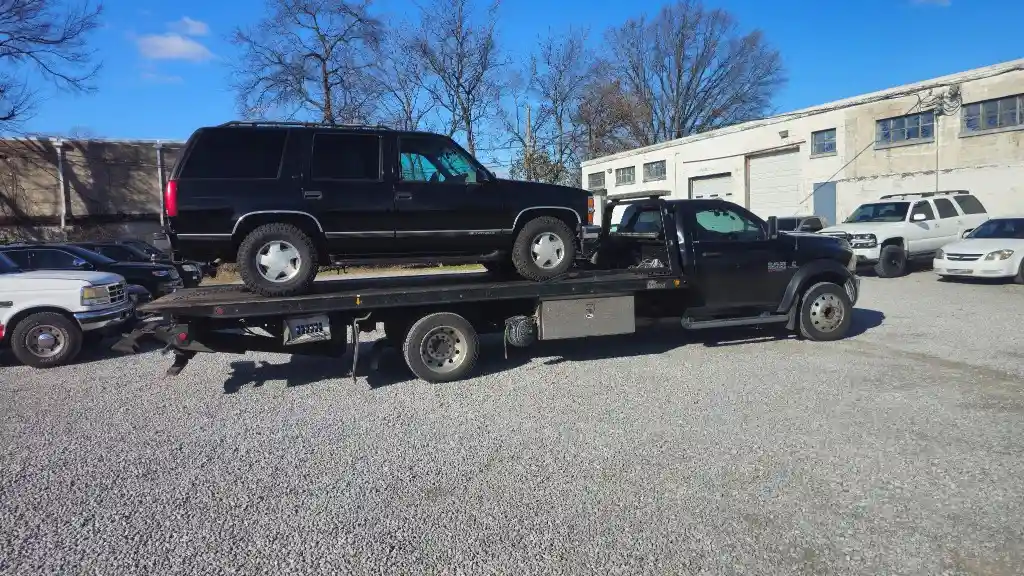
For any all-wheel-drive vehicle, there is exactly one universally safe method: a flatbed tow truck with all four wheels off the ground. That's it. No wheel-lift, no tow dolly, no strap behind a friend's pickup. If any driven wheel is spinning while the engine is off, the drivetrain is being damaged — the only question is how much, and how quickly.
Here's the step-by-step of what a proper AWD tow looks like when you call for one:
- On the phone, tell the dispatcher your vehicle is AWD. Say the year, make, and model. Any dispatcher who doesn't ask for those details before quoting is guessing at the equipment.
- Confirm a flatbed is being dispatched. Not a wheel-lift, not a wrecker with a sling, not a dolly. If the dispatcher says "the driver will figure it out," refuse the service and call a company that owns flatbeds.
- Before the driver hooks anything, look at the truck. A flatbed has a long, flat deck that tilts down to street level. A wheel-lift has a small yoke that clamps the front or rear tires and drags the other two on the pavement — never acceptable for AWD.
- If your car is stuck in Park, ask whether the driver has skates or dollies. These are wheeled platforms that go under the locked tires so the car rolls onto the deck without any wheel spinning. A driver who suggests "we'll just yank it up" is going to shred your parking pawl.
- Confirm all four wheels are secured on the deck before the truck moves. Soft straps around the tires, not chains over the axles. The car should be perfectly stationary relative to the truck.
That's the safe method. Anything else — every shortcut, every "it's only a short distance," every friend with a strap — starts the damage clock. I'll show you what that damage actually costs in the next section.
What Improper AWD Towing Actually Costs to Repair
When someone tows an AWD vehicle with two wheels on the ground, the wheels on the pavement are spinning at 60 mph and the wheels on the truck are stationary. Your transfer case and center differential — the parts that split power between the front and rear axles — try to reconcile that impossible input. Without the engine running, there's no fluid circulating to lubricate them. Within one mile, the internal chain stretches, the clutch packs warp, and the bearings cook themselves. This isn't theoretical — it's what we see on repair estimates every month.
- Transfer case replacement: $2,000–$4,500. Ground zero for the damage. On luxury AWD SUVs it can hit $6,000.
- Center differential repair: $1,500–$3,000. Sometimes the gears strip; sometimes they fuse together.
- Transmission replacement: $4,000–$9,000. When the transfer case takes the initial hit, the transmission goes next because everything is coupled together and running dry.
Add it up and a single improper tow can easily land a repair bill north of $10,000. On luxury AWD SUVs, a single dragged tow can put the total repair well into five figures.
Which AWD Vehicles Are Most at Risk
Not every AWD system is the same, but they all share the same rule: if a driven wheel spins while the engine is off, something inside is being damaged. Here's how the common systems stack up.
Full-time AWD (highest risk)
These systems are always engaged. There is no button, no switch, no "2WD mode" — every wheel is always coupled to the drivetrain. Improper towing damages them fastest.
- Subaru — every model with Symmetrical AWD (Outback, Forester, Impreza, Crosstrek, Ascent, WRX). Subaru's owner's manual is explicit: "Serious damage will occur to the transmission if towed with any wheels on the ground."
- Audi Quattro — A4, A5, A6, Q3, Q5, Q7, Q8, S/RS variants. Audi requires flatbed transport.
- BMW xDrive — 3-Series xDrive, 5-Series xDrive, X1 through X7. BMW requires flatbed transport.
- Mercedes-Benz 4MATIC — C-Class, E-Class, GLC, GLE, GLS. Requires flatbed.
Part-time / on-demand AWD (high risk)
These vehicles primarily drive one axle but can engage the other automatically without warning. The engagement happens when the primary wheels lose traction — which is exactly what happens when they're spinning in the air on a wheel-lift truck. Every one of these needs a flatbed.
- Honda CR-V AWD, Pilot AWD, Passport
- Toyota RAV4 AWD, Highlander AWD, Venza
- Ford Escape AWD, Edge AWD, Explorer AWD
- Nissan Rogue AWD, Murano AWD, Pathfinder
- Chevy Equinox AWD, Traverse AWD, Blazer AWD
4WD trucks and SUVs
Selectable 4WD is slightly more flexible than full-time AWD, but only slightly. If the transfer case is in 4-Hi or 4-Lo, or the hubs are locked, towing on any driven wheel damages the transfer case. Even in 2WD mode, dragging the rear wheels can spin components inside the transfer case that shouldn't be moving.
- Ford F-150 4x4, F-250, Bronco, Raptor
- Jeep Wrangler, Grand Cherokee 4WD, Gladiator
- Toyota Tacoma 4WD, 4Runner, Land Cruiser
- Chevy Silverado 4x4, Tahoe 4WD, Suburban 4WD
- RAM 1500 4x4, 2500 4x4, Power Wagon
Electric vehicles (special case)
EVs deserve their own bucket. The electric motors are permanently coupled to the wheels through a fixed-ratio gearbox — there is no clutch, no neutral, no way to disconnect the drivetrain. Spinning any wheel back-feeds the motor and can fry the inverter, a $5,000–$15,000 repair. Every EV — Tesla Model 3/Y/S/X, Rivian R1T/R1S, Ford Mustang Mach-E, Chevy Bolt, F-150 Lightning, Kia EV6 — must go on a flatbed with all four wheels off the ground. See our Tesla towing guide for the full EV walkthrough.
Tow Method Comparison Chart
This is the quick-reference chart I wish every Nashville driver had saved on their phone. At 2 a.m. on the shoulder of I-65, you don't have time to dig through the owner's manual. Match your drivetrain to the correct equipment and refuse anything else.
| Vehicle Type | Flatbed | Wheel-Lift (Front Up) | Wheel-Lift (Rear Up) | Tow Dolly | Repair Cost if Wrong |
|---|---|---|---|---|---|
| Full-time AWD (Subaru, Audi, BMW xDrive) | Safe | Damage | Damage | Damage | $4,000–$9,000 |
| Part-time AWD (CR-V, RAV4, Escape) | Safe | Damage | Damage | Not advised | $2,000–$6,000 |
| 4WD truck (F-150, Wrangler, Tacoma) | Safe | Risky | Risky | Not advised | $2,000–$4,500 |
| Front-wheel drive (Civic, Camry, Corolla) | Safe | Not advised | Safe | Safe | $500–$2,000 |
| Rear-wheel drive (Mustang, Charger, 3-Series RWD) | Safe | Safe | Not advised | Safe | $500–$2,000 |
| Electric (Tesla, Rivian, Mach-E) | Safe | Damage | Damage | Damage | $5,000–$15,000 |
When in doubt, request a flatbed. The extra $30–$50 on the invoice is the cheapest insurance you'll ever buy for the drivetrain.
The DIY AWD Towing Trap
Sometimes the improper tow isn't from a cut-rate company — it's a well-intentioned friend with a truck and a yellow nylon strap. This is another common path to the same five-figure repair bill, often with added dangers. Pulling a disabled AWD car from a parking lot in Donelson to a shop in Hermitage seems simple, but it combines every worst-case scenario at once.
First, your disabled AWD car has no power brakes and no power steering. You have to stand on the brake pedal and both hands on the wheel just to keep the car in the lane. I've cleaned up accidents on Nolensville Pike where the towed car rolled right into the truck that was supposed to be saving it.
Second, those yellow straps aren't rated for this. When they snap under the tension of pulling a 4,000-pound Subaru, they recoil with enough force to shatter a rear window. Cosmetic tow hooks and bumper covers rip off and become projectiles.
Third — and most relevant here — the AWD driveline is spinning the entire time with no lubrication. You save $150 on a professional tow and inflict $5,000 in damage. It's a terrible bet.
If your car just won't start because of a dead battery or empty tank, you don't need a tow at all. Call for 24/7 roadside assistance, a jump start, or fuel delivery instead of moving the car.
How to Spot a Bad AWD Tow Before It Happens
Protecting your AWD vehicle starts with three questions before any driver hooks up. Ask them out loud, at the scene, before you sign anything.
- "My car is all-wheel drive — did you bring a flatbed?" If the answer is "no, a wheel-lift is fine for a short distance," they are wrong and you should refuse the service.
- "Can you guarantee all four wheels will be off the ground the entire time?" This is the only acceptable method for AWD.
- "Are you able to handle a car stuck in Park without dragging it?" This tests whether they have skates or dollies. If they don't, they'll drag the locked wheels and damage the parking pawl.
If the operator dismisses your concerns or acts annoyed, tell them to leave. A few awkward minutes are infinitely better than a destroyed car. Waiting an extra 30 minutes for the right truck to arrive is the smartest thing you can do.
Real Nashville Scenarios I've Handled
A few weeks back I pulled up to a job on Hillsboro Pike in Green Hills. Another company had already been dispatched to an Audi Q5 stalled at a red light. Their driver was rolling out a standard wheel-lift sling. I flagged him down, pointed at the Quattro badge, and the customer canceled his ticket right there. That two-minute conversation saved a $6,800 transfer case job.
Another regular scenario: a Vanderbilt student's Subaru Impreza dies on West End. Their instinct is to have a roommate with a pickup strap it home to Brentwood. I get the call three days later after the AWD light starts flashing and the transmission is slipping. By then the viscous coupling is already toast. See the complete guide to tow truck types for exactly which truck belongs on which job so you can spot the mismatch before it costs you.
The pattern is always the same: a rushed decision to save $50 or 20 minutes ends up costing thousands. Bookmark our 24/7 emergency towing page so the right truck is one tap away when it's your turn.
When Your Warranty Won't Help You
Here's the last, brutal truth. If your AWD vehicle is damaged because it was towed improperly, your manufacturer warranty will not cover the repair. Every AWD owner's manual clearly states the correct towing procedure. By allowing an improper tow you've voided that coverage. Your auto insurance might pay it, but you'll be filing a claim against the tow company's liability policy — a long, frustrating process that leaves you without a car for weeks.
From the tight corners on Music Row to the high-speed merges on the I-24/I-40 split, a breakdown in Nashville puts you under pressure. It's tempting to take the first truck that shows up. Don't. Knowing how to tow an AWD vehicle safely comes down to one simple action: all four wheels off the ground, on a flatbed, every single time.
Hook Em' Up Towing runs flatbeds sized for every AWD vehicle on the road — Subaru wagons through Audi Q7s and Tesla Model Xs. Call (615) 756-5330 and a real Nashville dispatcher will send the right truck the first time.
Questions About Your Situation?
Get a straight answer and an honest quote from a locally owned Nashville company