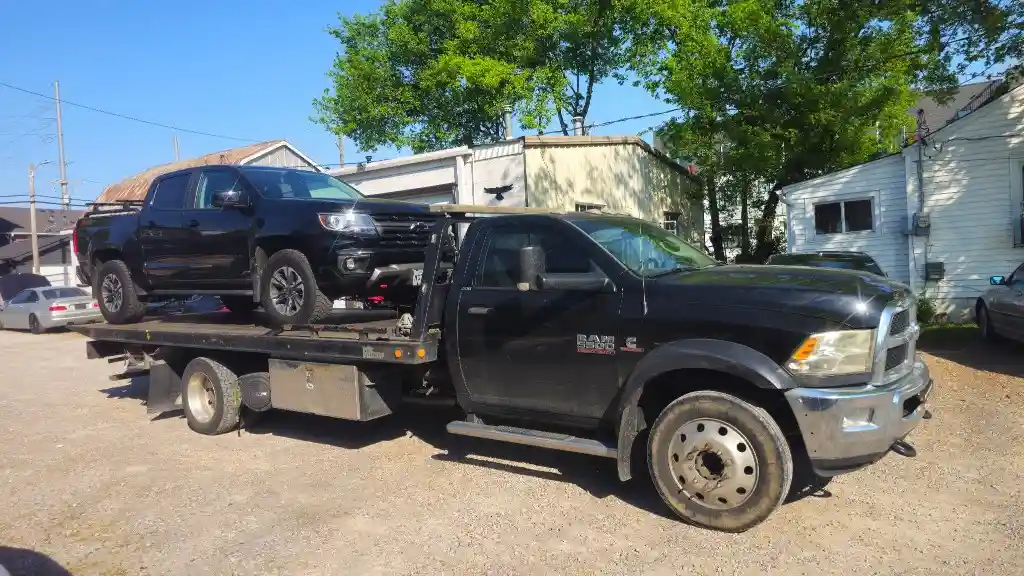
Page image supporting How to Tow a Dually Pickup — Nashville Capacity Guide. What dispatch must confirm before accepting a dually pickup: weight, dimensio…
Towing a Dually in Nashville: Weight, Wheel Geometry, and Trailer Rules
What dispatch must confirm before accepting a dually pickup: weight, dimensions, wheel condition, access, and available equipment.
Dually pickups are a category of towing all their own. A 3500 dually loaded with a fifth-wheel hitch and a slide-in toolbox can push 9,500 pounds empty — before you factor in a bed full of tools, a full fuel tank, or a horse trailer still hooked to the back. Standard light-duty flatbeds aren't rated to carry that weight. Wheel-lift wreckers with a 12,000-pound capacity are legal but risky. If you drive a dually in Nashville, here's what you need to know before you break down.
Weight Is the First Problem
A light-duty flatbed (Class 3 or 4 rollback) typically has a rated bed capacity of 8,000 to 10,000 pounds. On paper, that covers most empty duallies. In practice, "empty" is a lie — nobody's dually rolls around empty. Between the fifth-wheel hitch, a toolbox, spare tires, chains, fluids, tools, and whatever's in the bed, you're often 500 to 1,500 pounds over the rated capacity.
That doesn't mean the flatbed physically can't move the truck — it means the tie-down system, the winch, and the truck's own suspension are being asked to handle more than they were designed for. That's where things break. Straps snap, the winch cable frays, or the rollback's rear suspension bottoms out and blows a leaf spring.
For any 1-ton dually — F-350 DRW, 3500 DRW, Ram 3500 dually — the right truck is a heavy-duty flatbed (Class 5 or 6) with a 20,000-pound bed capacity and industrial-grade tie-downs. Some situations call for a medium-duty wrecker (integrated boom + underlift) if the truck is being towed rather than loaded.
Tell the dispatcher it's a dually up front. The truck they send matters.
The Dual Rear Wheel Complication
The other issue is geometry. A dually has dual rear wheels — four tires on the back axle — sitting inside wider fenders. A standard wheel-lift wrecker's cradle arms are sized for single rear wheels. On a dually, the arms can catch on the inner tire sidewall, damage the fender flare, or fail to grip properly.
The fix is either a wide-cradle wheel-lift with dually adapters, or (usually) a flatbed. Most operators go straight to a flatbed for duallies because the equipment tolerance is much wider.
Diesel-Specific Failures
Most Nashville duallies are diesel: Cummins, Powerstroke, Duramax. That means the breakdowns we see are diesel-pattern breakdowns:
Fuel starvation. A dually with the fuel gauge on E can lose prime on an incline, and diesels don't restart the way gas engines do — you often have to bleed the fuel system before it fires again. If you ran out of fuel, tell dispatch. We bring the primer kit and can usually get you rolling on-site instead of towing to a shop.
DEF and emissions faults. Modern diesels go into limp mode (5 mph max) when the DEF system throws a code. Sometimes it's a bad sensor, sometimes it's real. If your truck is stuck in limp mode, a tow to a diesel shop is usually the safe move — trying to drive 30 miles at 5 mph on I-24 is a recipe for a rear-end collision.
Dead batteries — plural. Duallies have two batteries in parallel. When one goes bad, it usually drags the other one down. A jump-start might get you started once, but if one battery has a dead cell, you'll be stranded again by tomorrow morning. Our jump kits can start dual-battery diesels, and we can test both batteries individually to tell you what's actually failing.
We wrote up the full breakdown checklist for diesel pickups in a dedicated diesel guide. Save it if you drive one.
When You're Hooked to a Trailer
The single most common dually call we get: "My truck won't start and I'm hooked to a trailer." Sometimes it's a horse trailer, sometimes a car trailer coming back from an auction, sometimes a loaded gooseneck full of equipment.
Here's the reality: we can't flatbed a truck-and-trailer combo. We have to separate them. If the trailer is empty and light, we can leave it parked and come back for it. If it's loaded — especially with animals or valuable equipment — the play is usually:
- Send a second truck to hook the trailer and haul it separately (either to your destination or to a safe stage point)
- Or, if the truck's problem is minor (dead battery, bad fuel, blown fuse), fix it on-site so you can pull the trailer yourself
Tell dispatch about the trailer on the first call. If we have to send two trucks, we want them rolling together, not one showing up and discovering the situation.
Fifth-Wheel and Gooseneck Hitch Considerations
If your dually has a fifth-wheel or gooseneck hitch in the bed, that's usually not a problem for a flatbed load — but the operator needs to know it's there. The hitch head sits above the bed rails on some setups and can catch the flatbed's tie-down points as the truck rolls up the ramp. We work around it, but again, front-of-mind knowledge on the phone saves 20 minutes on-scene.
Nashville Situations We See Most
Jobsite retrievals. Duallies parked at construction sites off Charlotte Pike or in the Nations often need to be pulled from soft ground. That's a winch-out call, not a straight tow — and winching a 10,000-pound truck out of mud requires proper equipment, not a strap and a hope.
Trailer sway aftermath. After a trailer-sway incident on I-24, the truck itself might drive fine but the driver's shaken. If you pulled off after a scare, we can transport the truck-and-trailer combo to a safe lot so you can regroup — no shame in that call.
The Dually Bottom Line
A dually is a heavy, wide, powerful vehicle that punishes anyone who tries to tow it with the wrong equipment. When you call (615) 756-5330, tell us it's a dually, tell us diesel or gas, and tell us whether you're hooked to a trailer. We'll send the truck that can actually do the job — a heavy-duty flatbed or medium-duty tow rig — instead of a light-duty rollback that shows up and can't handle the load.
Save the number now. Dually breakdowns are rare, but when they happen, they usually happen at the worst possible time — a work trip, a horse show, a jobsite deadline. Having the right number saved beats searching Google in a bad-service area.
Hook Em' Up Towing — Nashville's Trusted Choice
Locally owned since 2010, serving every Nashville neighborhood with fast, fair service