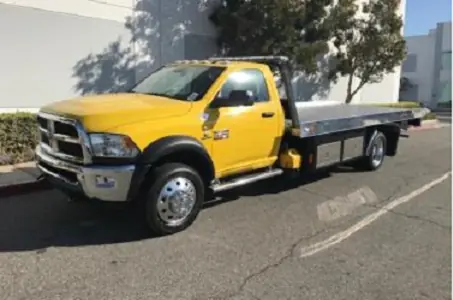
Page image supporting Diesel Pickup Breakdown: What to Do Before You Call. The breakdown details, dimensions, weight, and access information dispatch need…
First Moves When a Diesel Pickup Quits on You
The breakdown details, dimensions, weight, and access information dispatch needs before accepting a diesel-pickup tow.
Why a Standard Light-Duty Truck Often Can't Tow Yours
The first thing dispatch asks when someone says "my truck broke down" is the model. A Ram 2500, F-250, or Silverado 2500 can weigh 7,500–9,000 pounds empty. With a loaded bed or a trailer attached, that climbs past 12,000. Most light-duty wreckers max out at 10,000 pounds GVWR on the casualty — meaning they legally and safely can't lift your truck.
Trying anyway leads to two problems. The wrecker's rear axle squats under the load, lifting weight off its own steer tires and turning the rig into a handling problem on the highway. Or the boom flexes, the lift cylinder over-pressurizes, and the truck bounces on the way home. Either way, a medium-duty tow truck is the right call for any diesel pickup that's loaded, has a 4WD/AWD drivetrain, or is dual-rear-wheel.
If your truck is empty, two-wheel-drive, and a single-rear-wheel half-ton diesel (those exist but are rare), a heavy light-duty flatbed can usually handle it. Dispatch makes that call based on the VIN and what you tell them about the load.
The Diesel-Specific Failures That Strand You
Diesel breakdowns cluster around a few specific systems, and recognizing the symptom helps the operator bring the right truck.
Fuel system contamination. Modern common-rail diesels run injection pressures over 30,000 PSI, and the high-pressure pump has tolerances measured in microns. A single tank of contaminated fuel — water, gasoline mistake, bad station — can grenade the pump and send metal shavings through every injector. Symptom: hard start, rough idle, then a no-start. Don't crank repeatedly; you're pumping debris further into the system. This is a flatbed-only tow with the fuel system isolated.
DEF and emissions limp mode. All post-2010 diesels run a Diesel Exhaust Fluid system. When the DEF tank runs dry or the sensor faults, the truck enters a derate sequence — first reducing power, then limiting top speed, finally refusing to start after the next shutdown. If your dash is showing a countdown of "starts remaining," do not turn the truck off until you reach a safe location. Once it's down to zero, it's a tow.
Glow plug or starting system failure in cold weather. Diesels need help to start below about 40°F. A weak glow plug controller or a single failed plug usually shows up as a long crank with white smoke and a no-start. Jumping the batteries usually doesn't fix it because diesels run dual batteries in parallel and the failure is downstream. Symptom: cranks fine, won't catch.
Turbo or boost system failure. A blown intercooler hose, a stuck wastegate, or a failed turbo will throw a check engine light and put the truck in reduced-power mode. The truck will usually run, but pulling a trailer in that state can stress the transmission and the engine. Drive it home only if you're empty and close.
Don't Try to Two-Wheel-Down a 4WD Diesel
This is the biggest single mistake I see — a driver lets a roadside-assistance contractor hook a wheel-lift to the back of their 4WD F-250 and tow it to the dealer with the front wheels rolling. The transfer case in a part-time 4WD truck doesn't have a separate pump. When the front driveshaft spins without the engine running, the front output shaft spins through dry bearings. Twenty miles down the road, the transfer case has eaten itself.
Same principle as the AWD towing rules for cars, just with much bigger repair bills. For many diesel 4WD trucks a flatbed is the preferred choice, but check the owner's manual for your exact truck and tell dispatch the drivetrain before a truck is sent.
What to Tell Dispatch When You Call
The faster you give the right information, the faster the right truck arrives. The five things we need:
- Make, model, year, and engine — "2019 Ram 2500 Cummins" tells us drivetrain, weight, and fuel system
- 2WD or 4WD — Determines flatbed vs. medium-duty wheel lift
- Loaded or empty — Tools, gravel, or a slide-in camper changes the truck we send
- Trailer attached? — A separate piece of equipment, sometimes a separate truck call
- What's it doing? — No-start, won't shift, smoke, dash lights, fluid puddle
If you've got a goose-neck or fifth-wheel trailer attached, leave it hooked up for the photo but be ready to drop it if the recovery requires a different angle. We can also separately transport equipment trailers when needed.
Big Trucks Are a Long-Distance Question, Too
Diesel pickups frequently break down on the way to or from a job site or a trailering trip — meaning the breakdown isn't 5 miles from home, it's 200. The economics of having the truck repaired locally vs. towed home depend heavily on the diagnosis.
A no-start with a clear diagnosis (failed glow plug controller, dead lift pump) might be cheaper to fix locally and drive home. A drivetrain failure or a wreck almost always justifies long-distance transport back to your regular shop, especially if specialty parts are involved. We can quote per-mile rates and help you make the call before the truck is loaded.
A Quick Word on Trailer Recovery
If the trailer broke loose, jackknifed, or slid off the road, that's a separate call from the truck — different equipment, different rigging, different liability. Don't try to pull a loaded gooseneck back onto pavement with the truck still attached. The geometry of a partially-detached trailer pulling sideways will roll it before it rights itself. Disconnect, secure, and call.
Hook Em' Up Towing dispatches medium-duty equipment for diesel pickups, dual-rear-wheel trucks, and loaded fleet vehicles across Nashville. Call (615) 756-5330 for a current arrival estimate.
Hook Em' Up Towing — Nashville's Trusted Choice
Towing and roadside assistance across Nashville, available 24/7