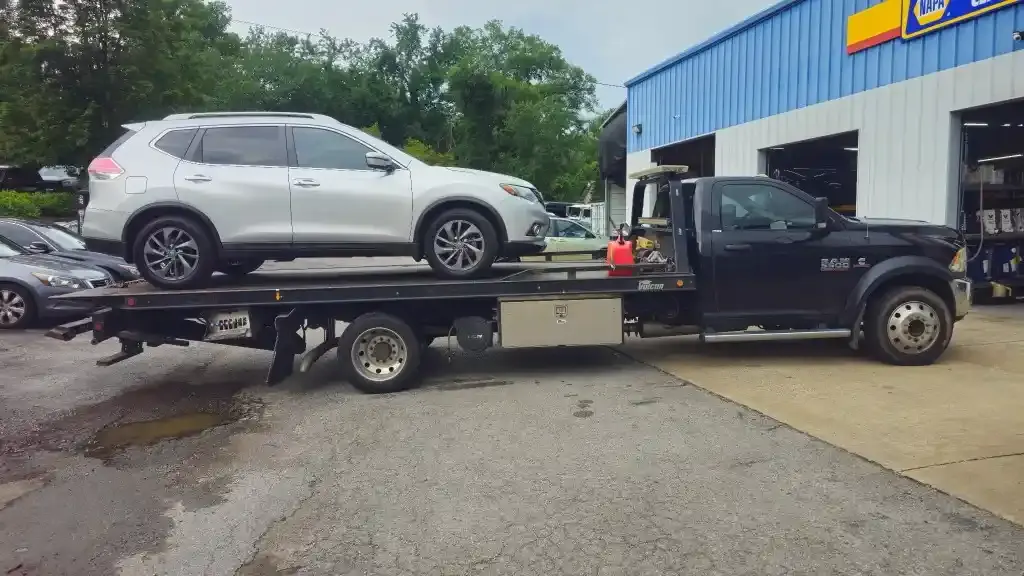
Page image supporting The Real Cost of Ignoring Dashboard Warning Lights. Ignoring a check engine light on I-40 can turn a $50 sensor fix into a $2,000 to…
Why Nashville Drivers Shouldn't Ignore Dashboard Alerts
Ignoring a check engine light on I-40 can turn a $50 sensor fix into a $2,000 tow and repair. Learn the true costs of skipping dashboard warning lights.
I was sitting on the shoulder of I-24 East near the Bell Road exit last Tuesday, watching the rain hit my windshield, waiting for the TDOT SmartWay truck to finish blocking a lane so I could safely hook up a late-model SUV. The driver was standing behind the guardrail, soaked and staring at a plume of steam coming from under his hood. When I finally got him in the cab of my truck, he looked at me and said, "That little red thermometer light has been flickering for three days. I thought I could make it to the weekend."
That "little light" ended up costing him a warped head gasket and a three-mile tow that could have been avoided with a fifteen-minute coolant top-off. After ten years of running calls for Hook Em' Up Towing, I’ve seen this exact scenario play out from Antioch to Bellevue. People think dashboard warning lights are suggestions. They aren't. They are your car’s way of screaming for help before it decides to quit in the middle of a four-lane merge on Briley Pkwy.
The Psychology of the Check Engine Light
We have all done it. You’re driving down West End, heading to a meeting or picking up the kids, and that amber outline of an engine pops up. Your heart sinks for a second, but the car still feels fine. It isn't shaking, there’s no smoke, and the radio still works. So, you keep driving. You tell yourself you’ll get it scanned at the parts store eventually.
The problem is that the check engine light is a catch-all. It could be something as stupid as a loose gas cap not creating a vacuum seal, or it could be your catalytic converter slowly choking to death. When you ignore it, you aren't just risking a breakdown; you’re actively burning money. A car running with a triggered MIL (Malfunction Indicator Lamp) is almost always running in "limp mode" or a rich fuel state. You’re dumping unburnt gas into your exhaust, killing your fuel economy, and carbon-coating your valves.
The Red vs. Amber Hierarchy
In the towing world, we categorize calls by how much metal is currently grinding against other metal. Your dashboard does the same thing with color coding. If you see an amber or yellow light, the computer is telling you there is a problem that needs attention soon. You can usually drive it home or to a shop, but don't take it on a road trip to Knoxville.
If a light is red, that is a hard stop. A red light means immediate mechanical failure or a safety hazard is occurring. If you see a red oil pressure can or a red temperature gauge while you're cruising down I-40, you need to pull over immediately. Not "at the next exit." Not "when I get to the gas station." Right now. By the time that red light stays solid, the damage is happening in real-time.
The Oil Pressure Light: The Silent Killer
If the red oil can light comes on, your engine has lost the ability to circulate lubricant. Without oil pressure, the metal bearings in your engine are touching the crankshaft. At 70 mph, your engine is spinning at maybe 2,500 RPMs. That is a lot of friction. I’ve picked up trucks on Nolensville Pike where the owner tried to "limp it home" with no oil pressure, and by the time I got there, the engine was welded shut. That’s the difference between a $150 oil pressure sensor replacement and a $6,000 engine swap.
The Brake System Warning
If you see a red circle with an exclamation point or the word "BRAKE," and your parking brake isn't engaged, you have a hydraulic failure. Nashville traffic is stop-and-go, especially around the split where I-65 and I-40 meet. If your brake fluid is low enough to trigger that light, you are one hard press away from the pedal hitting the floor. We do a lot of roadside assistance calls, but we can't fix a blown brake line on the shoulder. That’s a tow every single time.
The Hidden Costs of Procrastination
When people talk about the cost of car warning signs, they usually just think about the mechanic's bill. But as a dispatcher, I see the secondary costs that people forget to budget for.
- The Emergency Premium: A scheduled repair at your local shop in Donelson is one price. An emergency repair after you’ve been towed in on a hook is often more expensive because you don't have time to shop around for quotes.
- The Towing Fee: While we try to keep our rates fair at (615) 756-5330, an emergency recovery off a busy interstate at 5:00 PM is an added expense you wouldn't have if you had just driven the car to the shop when the light first flickered.
- Safety Risks: Standing on the side of Briley Pkwy while cars whiz by at 80 mph is dangerous. I’ve had mirrors clipped while loading cars. I don't want you out there, and you shouldn't want to be there.
- Secondary Damage: A cooling system leak that triggers a light might cost $200 to fix. If you overheat the car, you warp the cylinder head. Now you're looking at machine shop labor, new gaskets, and maybe a cracked block.
The "Flashing" Light Rule
Here is an operational detail most drivers don't know: there is a massive difference between a solid light and a flashing light. If your dashboard warning lights—specifically the check engine light—start flashing rapidly, that indicates a "Type A" misfire. This means raw fuel is being dumped into the exhaust stroke and is literally burning inside your catalytic converter. A converter can reach 1,200 degrees Fahrenheit in minutes. I have seen cars catch fire on the shoulder of the road because the driver ignored a flashing light and the exhaust system got hot enough to ignite the undercoating or dry grass beneath the car.
If it flashes, kill the engine immediately. Do not try to drive it another mile.
Modern Tech and False Security
Newer cars are worse about this because they have so many sensors. I’ve had customers in Hermitage tell me, "Oh, that light is always on, it’s just a sensor." Maybe it was a sensor six months ago. But if a real problem develops, you’ll never know because the light was already on. You’ve effectively blinded yourself to the vehicle's health.
We see a lot of European cars near Music Row that have very sensitive electronics. A battery that is starting to fail will throw a dozen different "ghost" lights—ABS, Traction Control, Airbag. If you see a Christmas tree of lights pop up all at once, it’s usually your alternator or battery. Getting a jump start might get you moving, but it won't fix the underlying issue that’s going to leave you stranded at a green light in Midtown tomorrow morning.
Transmission Temperature: The Heavy Duty Warning
For the folks driving work trucks or towing trailers through the hills of Tennessee, keep an eye on the transmission temp. If that light hits, your fluid is breaking down. Once transmission fluid burns, it loses its ability to provide friction for the clutches. If you ignore that warning, you’ll be calling us for medium-duty towing because your truck won't be able to find a gear. A transmission flush is cheap; a rebuilt Allison or 68RFE is not.
What to Do When the Light Comes On
If you're driving in Nashville and a light pops up, here is the professional operator's advice:
- Check the gauges: Is the temp needle climbing? Is the oil pressure gauge dropping? If yes, get off the road.
- Listen and Feel: Do you feel a vibration? Do you smell sweet maple syrup (coolant) or burning sulfur (catalytic converter)?
- Tighten the Gas Cap: It sounds like a cliché, but it works 10% of the time. Click it three times and see if the light resets after a few drive cycles.
- Get a Scan: Most auto parts stores will plug in an OBD-II scanner for free. Write down the code (it starts with a P, like P0300). Don't just let them sell you parts; take that code to a mechanic you trust.
Don't Let a Light Ruin Your Week
At the end of the day, your dashboard is a diagnostic tool designed to save you money. It’s early detection. When you ignore it, you’re betting that your mechanical intuition is better than the hundreds of sensors the engineers put in that vehicle. That’s a bet you’ll eventually lose.
I’ve spent a decade hauling cars away from the side of the road that didn't need to be there. Most of those drivers saw the warning signs days or weeks in advance. They just hoped it would go away. It never goes away; it just gets louder and more expensive.
If you find yourself in a spot where the light stayed on too long and the engine finally gave up, we’re here to help. Whether you're stuck on the shoulder of I-65 or in your driveway in Charlotte Pike, we can get you to a shop safely.
Keep an eye on those gauges and stay safe out there.
Stranded or Stuck? We're Ready.
Our dispatchers are standing by around the clock — one call and a truck is on the way