Sorting Out the Tow Bill When the Crash Wasn't Your Fault
Tennessee at-fault rules, police-directed tows, storage fee traps, and the documentation that gets you reimbursed — from an operator who's hauled wrecked cars in Nashville since 2010.
Insurance & Costs • June 10, 2026 • Hook Em' Up Towing Team
I probably roll up to more accident scenes in a year than most drivers see in a lifetime. The crash itself is already handled — police are there, maybe an ambulance, everybody's exchanging information — and then somebody looks at their disabled car and asks the question that always comes next: "Who's paying for the tow?"
The answer depends on who's at fault, what kind of insurance everybody carries, and whether the police are directing the tow or you're choosing it. I've been hauling wrecked cars in Nashville since 2010, and here's how the money flow actually works after a Tennessee crash.
Police-directed tows vs your choice
If your car is in the travel lane on I-40, I-65, or I-24, Metro police or the THP will usually call for a tow to clear the roadway. That's a police-directed tow, and in most cases you do not get to choose the company. The officer rotates through an approved rotation list.
Here's what drivers don't always realize: a police-directed tow goes to a storage lot or impound, and storage fees start the moment the car arrives. In Davidson County, those fees are regulated — but they still add up daily. If your car sits for three days while you argue with an insurance company, you could be looking at several hundred dollars in storage on top of the hook fee.
If your car is off the roadway and drivable, or if it's in a parking lot, you generally get to choose your own tow. That's where calling us directly saves you money. We take the car where you want it — your house, your shop, your driveway — and you avoid the impound storage clock entirely.
When the at-fault driver's insurance pays
Tennessee is an at-fault state. If the other driver caused the crash, their liability insurance is responsible for your property damage, including the tow. In theory, that's straightforward. In practice, it takes time.
The at-fault insurer won't cut a check until they've accepted liability, which means reviewed the police report, talked to their insured, and made a determination. That can take days. During those days, your car might be at a storage lot.
Your options:
- Pay the tow and storage yourself, keep every receipt, and submit them to the at-fault insurer for reimbursement. This is the cleanest route if you can float the money temporarily.
- Use your own collision coverage if you have it. Your insurer pays the tow, fixes the car, and goes after the at-fault insurer through subrogation. You'll pay your deductible up front and get it back if your company recovers successfully.
- Let the car sit at the storage lot and hope the at-fault insurer moves fast. This is the most expensive option. Storage fees compound daily, and insurers are not in a hurry.
If you're not at fault and the other driver is uninsured, your uninsured motorist property damage coverage — if you carry it — should cover the tow. Tennessee does not require UM property damage, so many drivers don't have it. Check your declarations page before you assume.
When you pay out of pocket even if it's not your fault
There are three situations where you're eating the tow bill even though somebody else caused the crash.
First, the at-fault driver is uninsured and you don't carry uninsured motorist property damage. Second, the at-fault insurer delays liability acceptance and you choose not to pay upfront, so the storage bill balloons before they act. Third, you didn't move the car to a reasonable location promptly, and the insurer claims "mitigation of damages" — meaning you could have limited the cost and didn't.
That last one is rare, but I've seen it. Driver leaves a wrecked car at a downtown storage lot for two weeks while they vacation. The insurer pays the initial tow but disputes the storage because the driver didn't act to minimize costs.
What storage actually costs in Nashville
Metro-approved storage lots in Davidson County charge regulated rates. As of 2026, the daily storage fee for a standard passenger vehicle is typically $20 to $35 per day, plus an initial intake fee. After a police-directed tow, there's usually an administrative release fee as well.
Those numbers sound small until they multiply. Five days at $30 is $150. Ten days is $300. Add the initial hook fee of $125 to $200, and a fender-bender can generate $500 in tow and storage before a single wrench turns on the repair.
If your car is at a Metro lot and you're disputing the fees, you have rights. Our vehicle owner rights guide breaks down Tennessee's fee caps, signage requirements, and how to file a complaint with the Tennessee Motor Vehicle Commission.
What to do at the scene
The decisions you make in the first ten minutes after a crash affect the tow bill more than anything that happens later.
If the car is drivable and safe to move, get it to a parking lot or shoulder and call your chosen tow company directly. If it's not drivable, ask the officer whether the tow is mandatory or voluntary. If it's mandatory, get the name of the company, the destination lot, and a receipt or incident number before you leave the scene.
Take photos of everything — damage, position, license plates, the other driver's insurance card, the officer's badge number, and the tow truck itself. That documentation is what gets you reimbursed.
If you're injured, don't worry about the car. Your health matters more than the tow bill. But if you're uninjured and thinking clearly, those early decisions save hundreds.
Why a flatbed matters after a crash
A lot of wrecked cars have hidden suspension, steering, or wheel damage that isn't obvious at the scene. A wheel-lift tow with damaged steering components can drag the front wheels sideways and turn a $500 repair into a $2,000 one. After any collision where the front end took a hit, request a flatbed.
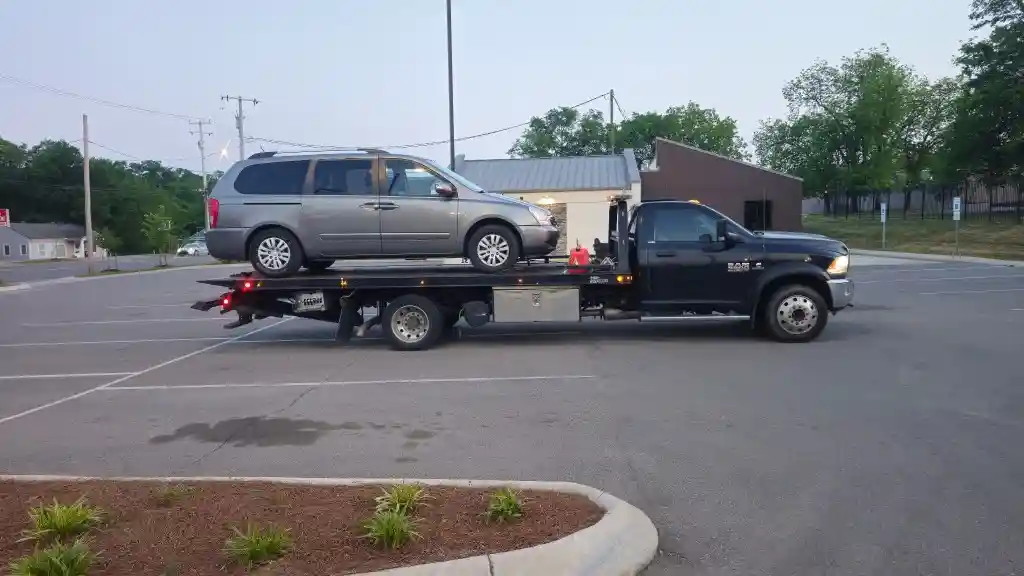
Our flatbed towing service is what we send to most accident scenes for exactly this reason. If the frame, suspension, or drivetrain might be compromised, all four wheels off the ground is the only safe move.
The bottom line
Who pays for towing after an accident? Ideally, the at-fault driver's insurance. Practically, it might be you first, with reimbursement later. The key is keeping the car out of expensive storage, documenting everything, and not letting an insurance dispute turn a $150 tow into a $600 storage bill.
If you've just been in a crash in Nashville and need the car moved now — to your shop, your home, or anywhere else — call Hook Em' Up Towing at (615) 756-5330. We'll quote you before the truck rolls, give you a detailed receipt for your insurer, and make sure your car gets where it needs to go without the storage-lot markup.
You can also read up on the most dangerous intersections in Nashville — knowing the high-risk spots helps you stay out of this situation in the first place.
Hook Em' Up Towing — Nashville's Trusted Choice
Locally owned since 2010, serving every Nashville neighborhood with fast, fair service
Call Now: (615) 756-5330