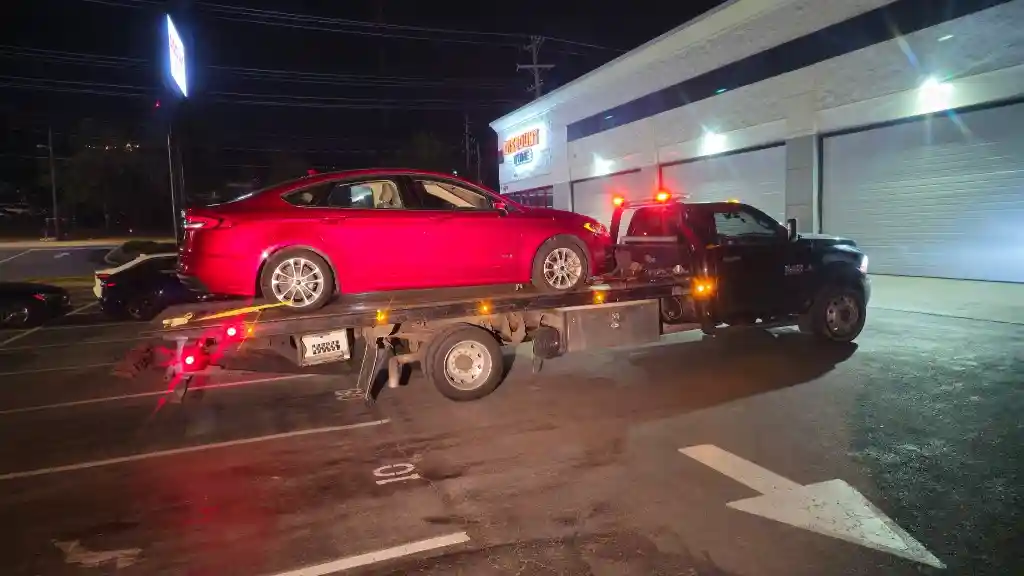
Page image supporting Flatbed vs Roadside vs Jump Start: Which to Call. A Nashville operator’s triage for the three most-requested calls — flatbed towing,…
Picking the Right Nashville Service: Flatbed, Roadside, or Jump Start
A Nashville operator’s triage for the three most-requested calls — flatbed towing, roadside assistance, and jump starts. Pick the right truck before you dial.
You're stopped on the shoulder of I-440, the dash is lit up, and the dispatcher on the other end of the line asks the question every Nashville driver eventually faces: do you need a tow, a roadside fix, or just a jump? Picking the wrong one wastes 45 minutes and, in some cases, costs you an extra service fee when the first truck arrives unable to help.
This guide is the same triage I run with every caller. It walks through the three most-requested services we send out of our Fordomatic Dr yard — flatbed towing, roadside assistance, and battery jump starts — and shows you exactly which one matches your situation before you ever pick up the phone.
The 30-Second Triage
Before any of the detail below, three questions narrow it down fast:
- Will the engine even crank? No crank, no click, or a single loud click — likely a battery problem. That's a Nashville jump start dispatch.
- Does the car run, but something is preventing you from driving it? Locked out, out of fuel, flat tire, low on coolant, stuck off the pavement — that's on-scene roadside assistance.
- Is the vehicle physically undriveable, damaged, AWD/4WD, lowered, or going to a shop? That's a flatbed tow truck — every time.
If you can answer those three with confidence, you've already picked the right service. The rest of this article exists for the gray-area calls — the ones where two services overlap and one is clearly cheaper or faster.
When a Jump Start Is the Right Call
Jump starts are the smallest, cheapest, and fastest dispatch we run. The truck rolls up with a lithium jump pack, hooks to the battery (positive on the terminal, negative on an engine ground), fires the engine, and runs a digital load test before leaving. Total time on scene is usually under 10 minutes.
The classic jump-start fingerprints:
- You left the dome light, hazards, or a phone charger on overnight.
- Cold morning, the starter cranks slowly for a second, then quits.
- One loud click when you turn the key, then nothing.
- The car has been sitting unused for two weeks or more.
- Dash electronics flicker, clock resets, or radio presets are gone.
What a jump start will not fix: a failed alternator (the car will die again within 10–30 minutes of leaving), a bad starter motor (a working battery still won't crank the engine), or a fuel pump issue (cranks fine but won't catch).
If you've already been jumped once today and the car died again, skip the second jump — that's a tow call. We cover the why in detail in our dead battery and alternator guide.
When Roadside Assistance Is the Right Call
Roadside assistance is the bucket for everything that isn't a tow and isn't a jump. The vehicle is mechanically fine, but a single missing thing — a key, a gallon of fuel, an inflated tire — is keeping you parked. We arrive, restore that one thing, and you drive away.
Send a roadside truck when:
- You're locked out. Doors, trunks, even modern proximity-key vehicles. We carry long-reach tools and air wedges that don't damage weather seals.
- You're out of fuel. We bring enough gas or diesel to get you to the nearest station — not a full tank, but enough that you're rolling again.
- You have a flat tire. If the spare is good, we swap to it on-scene. If the spare is missing or also flat, we shift to a tow.
- You're stuck just off the pavement. Soft shoulder, parking-lot curb, snowbank. Most light winch-outs take 5–15 minutes.
- You need fluids topped off — coolant on an overheated car, washer fluid, sometimes oil — to limp safely to a shop.
The decision rule: if the car can be driven away after a 10-minute fix, roadside is correct. If it can't be safely driven once we're done, we should've sent a flatbed instead.
When Flatbed Towing Is the Right Call
Flatbed is the most expensive of the three dispatches, but it's the only correct answer in a long list of situations. The deck tilts down, the vehicle gets winched on, all four wheels leave the ground, and the car rides to its destination with zero drivetrain stress.
You want a flatbed when:
- The car can't be driven safely — accident damage, drivetrain failure, no brakes, leaking fluids, smoke from under the hood.
- The vehicle is AWD or 4WD. Toyota, Subaru, most modern crossovers, Audi quattro, BMW xDrive — wheel-down towing damages the transfer case and rear coupler. Book our Nashville flatbed towing service so all four wheels stay off the ground.
- The vehicle is lowered, exotic, classic, or electric. Ground clearance is too low for a wheel-lift, or the manufacturer prohibits wheel-down towing entirely.
- The car needs to go more than 20 minutes away — to a specific shop, a body shop in another county, or a long-distance destination.
- A jump start didn't hold. Once a jumped car dies again, the alternator is suspect and the next stop is a shop, not the highway.
- The keys are lost and can't be made on-scene (some chip keys require dealer programming).
The cost difference between a wheel-lift and a flatbed for a typical Nashville call is usually only $50–$75 — small money compared to the $2,500+ transfer case repair a wrong-method tow can cause on an AWD SUV.
Common Gray-Area Calls and What We Send
These are the calls where two services genuinely overlap, and the right choice depends on one extra detail:
"Battery is dead and I've tried jumping it twice." → Flatbed. Two failed jumps means it's not just the battery — alternator or starter is the real problem, and the car shouldn't try to drive itself anywhere.
"Locked out, but the car has been sitting for three weeks." → Roadside first (lockout), and bring the jump pack as a precaution. A car that's been sitting that long often has a depleted battery too, so we plan for both in one dispatch.
"Flat tire on an AWD SUV." → Depends on the spare. A full-size matching spare is a roadside tire change. A donut spare on AWD is risky for any meaningful distance — most AWD systems can't tolerate the diameter mismatch, so we'll usually flatbed it to the tire shop instead. We covered the donut math in the donut spare tire limits guide.
"Out of fuel on the interstate shoulder." → Roadside if it's safe to work the shoulder. On I-65 or I-40 during rush hour, we sometimes flatbed the car to the next exit's gas station instead, because working a fuel-delivery service on a live interstate shoulder isn't worth the risk.
"The car runs but the check engine light just came on." → Almost never a tow. Roadside or a self-drive to a shop is fine unless the engine is misfiring badly, overheating, or losing power. A solid check engine light alone is not an emergency.
What Each Call Actually Costs (Nashville Averages)
Without quoting an exact price — every call has variables — here's the rough order of magnitude so you can plan:
- Jump start service: lowest of the three. Single, predictable dispatch with no per-mile fees.
- Roadside assistance (lockout, fuel delivery, tire change): typically a flat trip fee plus the materials (fuel cost passed through at cost, for example).
- Flatbed towing: trip fee plus per-mile rate beyond the included radius. Higher than roadside, but bundled — you don't pay extra if the load takes longer than expected.
For the full pricing breakdown, our Nashville towing rates and regulations guide covers the Metro Nashville non-consent caps and what a transparent invoice should look like.
What to Tell Hook Em' Up Towing Dispatch When You Call
The faster we can identify the right truck, the faster you're moving again. When you call (615) 756-5330, have these ready:
- Exact location — cross street or mile marker. Pin from Google Maps is ideal.
- What's happening with the car — won't crank, cranks but won't catch, runs but undriveable, locked out, etc.
- Make, model, year, drive type — especially AWD/4WD/EV. This determines whether we send a wheel-lift or a flatbed.
- Where it needs to go — home, specific shop, dealer, or "wherever's closest." Saves a callback later.
Get those four right and we'll usually have the correct truck rolling within two minutes of hangup, on a 30–45 minute ETA depending on where in Davidson County you are.
Frequently Asked Questions
Q: If I'm not sure between roadside and a jump start, which should I ask for? Ask for a jump start. Every truck we dispatch for a jump also carries the full roadside toolkit, so if it turns out to be something else, we can pivot on the spot. The reverse isn't always true.
Q: Can the same truck do all three services? Often yes — most of our wreckers can perform jump starts and basic roadside work in addition to towing. But we still ask up front so we can pick the right truck for the job (a flatbed is overkill for a lockout, and a service truck can't tow your wrecked F-250).
Q: How long does each service take from call to back-on-the-road? Jump starts: typically under 45 minutes total. Roadside (lockouts, fuel): under an hour. Flatbed tows: 30–45 minute arrival, plus the drive to your destination.
Q: Will my insurance or roadside membership cover all three? Most standard policies cover all three at some level, but the included mileage and trip count varies wildly. We covered the reimbursement playbook in does car insurance cover towing in Nashville.
Q: What if I guess wrong and the truck that arrives can't help? You'll usually still owe a trip fee for the dispatch, but we'll re-dispatch the correct truck and credit what we can. Easier to spend two extra minutes on the phone up front than to pay two trip fees.
When in doubt, call (615) 756-5330 and describe what's happening — we'd rather talk through it for a minute than send the wrong truck. We dispatch flatbeds, roadside service trucks, and jump-pack-equipped units across Davidson, Williamson, Cheatham, and Rutherford counties 24 hours a day.
Hook Em' Up Towing — Nashville's Trusted Choice
Locally owned since 2010, serving every Nashville neighborhood with fast, fair service