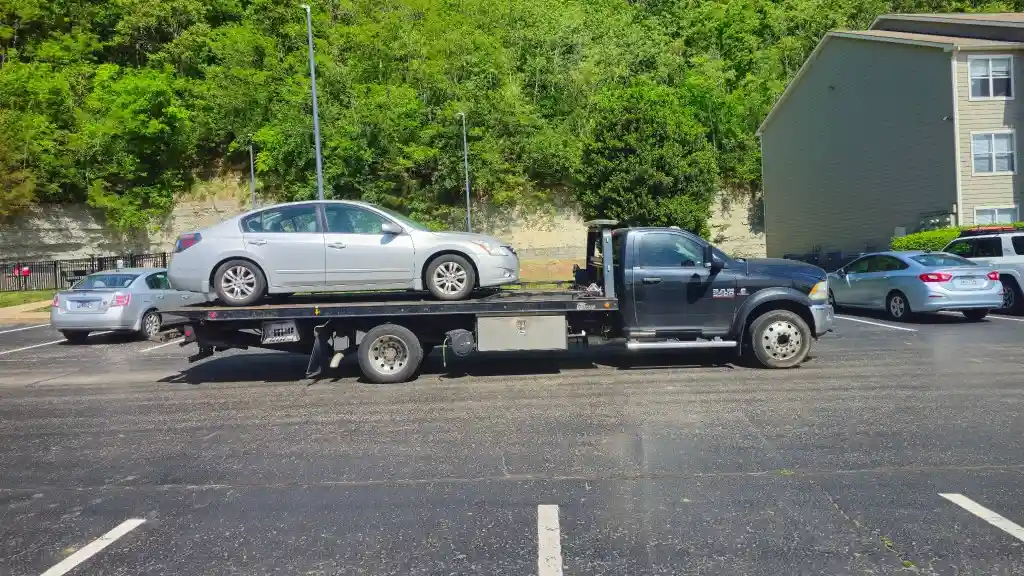
Page image supporting Transmission Slipping: When to Stop. The delayed-shift warning, the flared upshift, and the rev-without-go failure stage — an operat…
Spotting a Slipping Transmission Before Damage Gets Costly
The delayed-shift warning, the flared upshift, and the rev-without-go failure stage — an operator’s call on when to limp it home and when to stop now.
A transmission that's starting to slip is the most expensive warning a car gives you, and it's also the one drivers ignore the longest. Most of the dead-transmission tows I run in Nashville — limping off I-440, stuck at a light on Nolensville Pike, parked on the shoulder of Briley with the engine revving and the car not moving — started a week or two earlier as a delayed shift the driver shrugged off. Here's the operator's read on what slipping actually means, the warning sequence that comes before total failure, and the call on whether to drive it home or stop where you are.
What "Slipping" Actually Is
When a transmission shifts correctly, engine RPM and vehicle speed move together — RPMs climb, the box shifts up, RPMs drop, speed keeps building. Slipping is what happens when that link breaks down. The engine revs but the car doesn't accelerate at the same rate, or the shift happens with a delay, a flare, or a hard thud. Mechanically, one of four things is failing:
- Low transmission fluid. A leak from a pan gasket, cooler line, or output seal has dropped the level. Without enough fluid, the internal clutches and bands can't grip.
- Burnt, contaminated fluid. Heat has broken the fluid down. It can no longer transmit pressure cleanly. Clutch material is suspended in it as black grit.
- Worn clutch packs or bands. The friction surfaces inside the transmission are glazed or worn through. Even with good fluid and pressure, they can't hold.
- Failed valve body or solenoid. The hydraulic brain of the transmission has lost the ability to route fluid pressure to the right clutch at the right moment.
You can't tell which one it is from the driver's seat. What you can do is recognize the warning sequence and stop before "intermittent slip" becomes "no forward gears at all."
The Transmission Slip Warning Sequence Drivers Ignore Too Long
- Delayed engagement. You drop into Drive or Reverse and there's a one-second pause before the car actually goes. It feels like the transmission is "thinking." This is your free warning — pressure is marginal, fluid may be low, but nothing is broken yet.
- Flared upshifts under throttle. Accelerating onto I-65, you feel the RPMs rise, hang for a beat past where the shift should happen, then drop hard as the gear finally catches. This is a slipping clutch pack. The friction material is wearing right now, every shift.
- No-move or rev-without-go. You're in Drive, you press the gas, the engine revs to 3,000 RPM, and the car barely moves — or doesn't move at all. The transmission has lost the ability to transmit power. Continuing to drive is now causing additional damage by the second.
If you're at stage 1 or 2 and you're within a few miles of home or a shop, you can usually limp it carefully — light throttle, no highway speeds, no hills. If you're at stage 3, stop where you are and call for a tow. Every additional minute of revving on slipping clutches scorches more friction material into the fluid and turns a rebuildable transmission into a core swap.
The Decision: Drive It or Tow It?
Here's the call-or-drive heuristic I give callers who phone us mid-symptom:
- Slipping intermittent, only on heavy throttle, fluid level looks normal: Limp home or to a shop at part throttle, no highway. Get it checked this week.
- Slipping consistent on every shift, fluid smells burnt or looks dark: Tow it. The damage is active and every mile makes it worse.
- Hard shift thud followed by normal driving: Could be a solenoid. Drive carefully to a shop; have it scanned today.
- Reverse works but Drive doesn't, or vice versa: Tow. A specific clutch pack has failed; driving it in the working direction won't help, and the engine load on the failed pack can damage the case.
- Engine revs and car doesn't move at all: Tow. Don't restart it to "check again" — every restart adds load.
- Check-engine light or transmission-temp warning lamp on: Tow. The car's own sensors are telling you something is overheating or out of spec.
A transmission slipping uphill is more urgent than slipping flat. The grade out of downtown headed west on I-40, the climb on I-24 east toward Murfreesboro, or even Granny White Pike through Forest Hills all put sustained load on the box. A transmission that slips once on level ground may slip ten times on a grade and burn itself out in a single trip.
Why Limping It Home Is Risky
Drivers will often try to "just make it home" because home is closer than the shop, or because Sunday afternoon and the shop is closed anyway. Two things make this riskier than it sounds:
- Slipping clutches generate enormous heat. Friction material that should grip the steel plate is sliding instead. That sliding produces heat at the clutch surface — sometimes 300°F+ in seconds. The transmission fluid carries that heat away, but only up to a point. Once the fluid itself overheats, it loses viscosity, can't maintain pressure, and the slipping accelerates. This is the runaway failure mode that turns a marginal transmission into a destroyed one in a single highway merge.
- Failure happens with no warning. A transmission can go from "slipping a little" to "no forward gears" between one light and the next. If that happens in the middle of an intersection, on a freeway entrance ramp, or on a bridge with no shoulder, you're stranded in a dangerous spot — and now the tow truck has to recover you from somewhere far worse than where you started.
The shoulder logic we walked through for I-65 Nashville breakdowns applies here word-for-word: the safest place to stop is the safest spot you can get to right now, not the spot that's most convenient.
Why a Slipping Transmission Always Gets a Flatbed
When we dispatch on a "transmission won't shift" call, the truck that rolls is a flatbed — never a wheel-lift, never a dolly. The reason is the same as the SUV flatbed rule for AWD vehicles: you cannot safely tow a car with the driven wheels turning. With a transmission failure:
- Putting the car in Neutral doesn't disconnect the driven wheels from the transmission. The output shaft still spins.
- A spinning output shaft with no engine running means no fluid circulation through the pump. Internal bushings and bearings run dry.
- On a wheel-lift, the rear wheels (or front, depending on drivetrain) drag on the road for the entire tow. That rotation transmits back through the transaxle and can shred whatever clutch material is left.
A flatbed lifts every wheel off the pavement. The drivetrain stays stationary the entire ride. Whatever is left of the transmission to rebuild stays salvageable.
Why Nashville Traffic Stacks the Deck
Three local conditions push marginal transmissions over the edge faster than they would in a calmer city:
- Stop-and-go on the interstates. I-440, the I-24/I-40 split downtown, and the Briley loop have you cycling between 5 and 55 mph constantly. Every shift cycle works the clutches. Marginal clutch material that would last another six months on highway-only driving dies in three weeks of commute slogs.
- Long sustained grades. The pull out of downtown west on I-40, the climb on I-24 east, and the rolling hills on Franklin Pike all hold the transmission in a low gear under load. Slipping clutches generate more heat under load than under acceleration, and Nashville geography keeps the load on.
- Summer heat plus brake-and-go traffic. Transmission fluid temperature climbs fast when the car is moving slowly through hot air. The same conditions that strand overheated cooling systems also cook transmission fluid past its useful range.
What the Shop Will Ask You
If you do reach a shop on your own and the symptoms have already started, the diagnostician will want to know exactly what you felt and when. Notes you can take from the driver's seat that save real diagnosis time:
- Does it slip in cold start (first 5 minutes) or only when warmed up?
- Does it slip in every gear or just one specific upshift?
- Does it slip more in Drive or in Reverse?
- Is there any noise — whine, growl, clunk — that arrives with the slip?
- When did you last have the fluid changed, and was it ever towed-while-running or driven with the parking brake on?
The shop will read the codes, but the felt symptoms point to the failed component faster than the scanner alone.
The Short Answer
A delayed shift is your one free warning. A flared upshift means the damage is starting. Engine revving without forward motion means the transmission is done — stop where you are and call for a flatbed. Don't try to limp it home with the engine racing; every minute costs more than the tow does. Drive it carefully only at stage 1 with normal-looking fluid and short distances.
Hook Em' Up Towing dispatches flatbeds for transmission failures 24/7 across Nashville and the surrounding ZIPs. Call (615) 756-5330 for a flatbed so the transmission isn't driven further before it reaches the shop.
Questions About Your Situation?
Get a straight answer and an honest quote from a locally owned Nashville company