Page image supporting Brake Fade on Nashville Hills. Why long descents cook tired brake fluid, the four-stage fade sequence to recognize early, and the do…
How to Recognize Brake Fade Before Your Pedal Sinks
Why long descents cook tired brake fluid, the four-stage fade sequence to recognize early, and the downshift-and-runoff technique that stops a runaway.
Brake fade is the failure mode most Nashville drivers have never heard of and the one that's most likely to put them in a guardrail. It's not a leak, it's not a worn pad, and it doesn't show up on a state inspection — it's a temporary loss of stopping power that happens when brakes get too hot to do their job. On a flat city street it's almost impossible to trigger. On the descent into downtown from the I-40/I-65 split, on the long grade down Briley toward the airport, or on Granny White Pike coming out of Forest Hills, it happens to ordinary commuter cars every week. Here's the operator's read on why brakes fade, the warning sequence before total failure, and what to do when the pedal goes soft halfway down a hill.
What "Brake Fade" Actually Is
Brakes work by turning kinetic energy into heat. The pads squeeze the rotor, friction slows the wheel, and the resulting heat dumps into the rotor and out through the airstream. As long as the system can shed heat faster than it makes it, the brakes stay in their working temperature range — roughly 200–650°F for an OEM pad. The trouble starts when heat builds up faster than the rotor and pad can shed it. Three things then happen, in this order:
- Pad fade. The binder in the brake pad — the organic resin that holds the friction material together — starts to outgas. A microscopic film of gas forms between pad and rotor, and the pad effectively starts riding on its own boiling-off. The pedal still feels firm, but the car doesn't slow down the way it used to.
- Fluid fade. Heat soaks back through the caliper piston into the brake fluid. Brake fluid is hygroscopic — it absorbs water out of the air over years — and water boils at 212°F while DOT 4 fluid boils at 446°F or higher. The water dissolved in old fluid boils first, and the steam pockets compress when you push the pedal. The pedal goes soft and travels to the floor without stopping the car.
- Rotor glazing or warping. Sustained extreme heat anneals the rotor surface, glazes the pad face, or warps the rotor permanently. The pedal pulses, vibrates, or the brakes pull to one side after the car cools.
Pad fade comes back the moment the brakes cool down. Fluid fade comes back if you stop and let the steam recondense. Glazing and warping are permanent and require parts.
The Warning Sequence Before Total Failure
Brake fade isn't instant. It announces itself in stages, and Nashville's geography gives you just enough warning to act if you know what to feel for.
- The pedal feels normal but the car isn't slowing the way it should. You press the same amount and the car covers more ground before the speed drops. This is early pad fade. You have a few seconds to a few minutes before stage 2.
- A faint burning smell from the wheel wells. Sometimes sweet, sometimes acrid. That's the pad binder outgassing. The fade is now active — stop applying brakes and let them cool, or downshift to engine-brake.
- The pedal goes spongy or sinks toward the floor. Fluid fade has set in. Steam is now in your hydraulic lines. The brakes will not stop the car the way they did three minutes ago.
- The pedal goes to the floor with no resistance. Total fade. The car is no longer slowing on the brake pedal. This is where guardrails happen.
The window from stage 1 to stage 4 on a long downhill grade with an underprepared brake system is sometimes less than 90 seconds. Drivers who recognize stage 1 and downshift are fine. Drivers who keep riding the pedal hoping it'll feel firm again are the ones we pull off the shoulder.
The Right Way to Descend a Nashville Hill
The technique that prevents fade on every long grade in town is the same one truckers use, and it works on any passenger car or SUV:
- Downshift before the descent, not during it. Drop the transmission to a lower gear (D3, D2, L, or paddle/manual down a gear or two) before you start down the hill. The engine does the braking work on the way down; the friction brakes stay cool.
- Use the brakes in firm, short applications — not a long drag. A 3-second firm push that drops you from 55 to 45 sheds heat efficiently. A 30-second steady drag holding speed at 50 builds heat without ever giving the rotor a chance to cool.
- If you smell burning or feel the pedal soften, get off the brakes immediately and downshift further. Engine compression will slow you. The brakes need air across the rotor to recover, and they only get that when you stop riding them.
- Don't pump the brakes hoping to "build pressure." That works on the old non-ABS pedal feel of a low-fluid system, not on fluid fade. Pumping a faded system just churns more steam into the lines.
Specific Nashville grades where I see fade every season: the descent off I-40 westbound coming through downtown into the Cumberland River bridge, the long pull down Briley from Donelson toward the airport, Old Hickory Boulevard coming off the ridge into Bellevue, and Franklin Pike out of the Forest Hills bend. None of these are mountain passes, but they're long enough to cook tired fluid and worn pads.
Why Old Brake Fluid Is the Hidden Risk
The single most ignored part of a brake system is the fluid. Most owner's manuals call for a flush every two or three years. Most cars on Nashville roads have never had one done. Here's why that matters:
- Fresh DOT 3 fluid boils at about 401°F dry. After three years of absorbing humidity through the master cylinder and rubber lines, it's down to about 284°F. That's well within the heat range a single hard descent can generate.
- DOT 4 fluid starts at 446°F and degrades the same way. Five-year-old DOT 4 can boil at 311°F.
- Once you've boiled the fluid once, the steam pockets stay in the lines until the system is properly bled. Subsequent stops feel "off" until a shop flushes it.
If your car is more than three years old and you've never had the brake fluid flushed, the fade risk on a long descent is real even with new pads.
What to Do If Your Brakes Fade Right Now
If you're already mid-descent and the pedal has softened or the car isn't slowing:
- Downshift immediately. Pull the shifter into the lowest gear that won't over-rev the engine — D2, L, or paddle down two gears. Engine braking can shed serious speed with no help from the brakes.
- Pump the brakes lightly while looking for a runoff. Even partial brake function helps if you can find a shoulder, an uphill driveway, or a runoff ramp to bleed speed into.
- Use the parking brake as a last resort, gently and progressively. The parking brake is a separate mechanical system on most cars and isn't affected by fluid fade. Pull it slowly — yanking it locks the rear wheels and sends you sideways.
- Aim for the safest crash, not no crash. If you're going to leave the road, pick a guardrail or a soft shoulder over a head-on. This is the same triage we walked through for I-65 Nashville breakdowns — stop where it's least bad, not where it's most convenient.
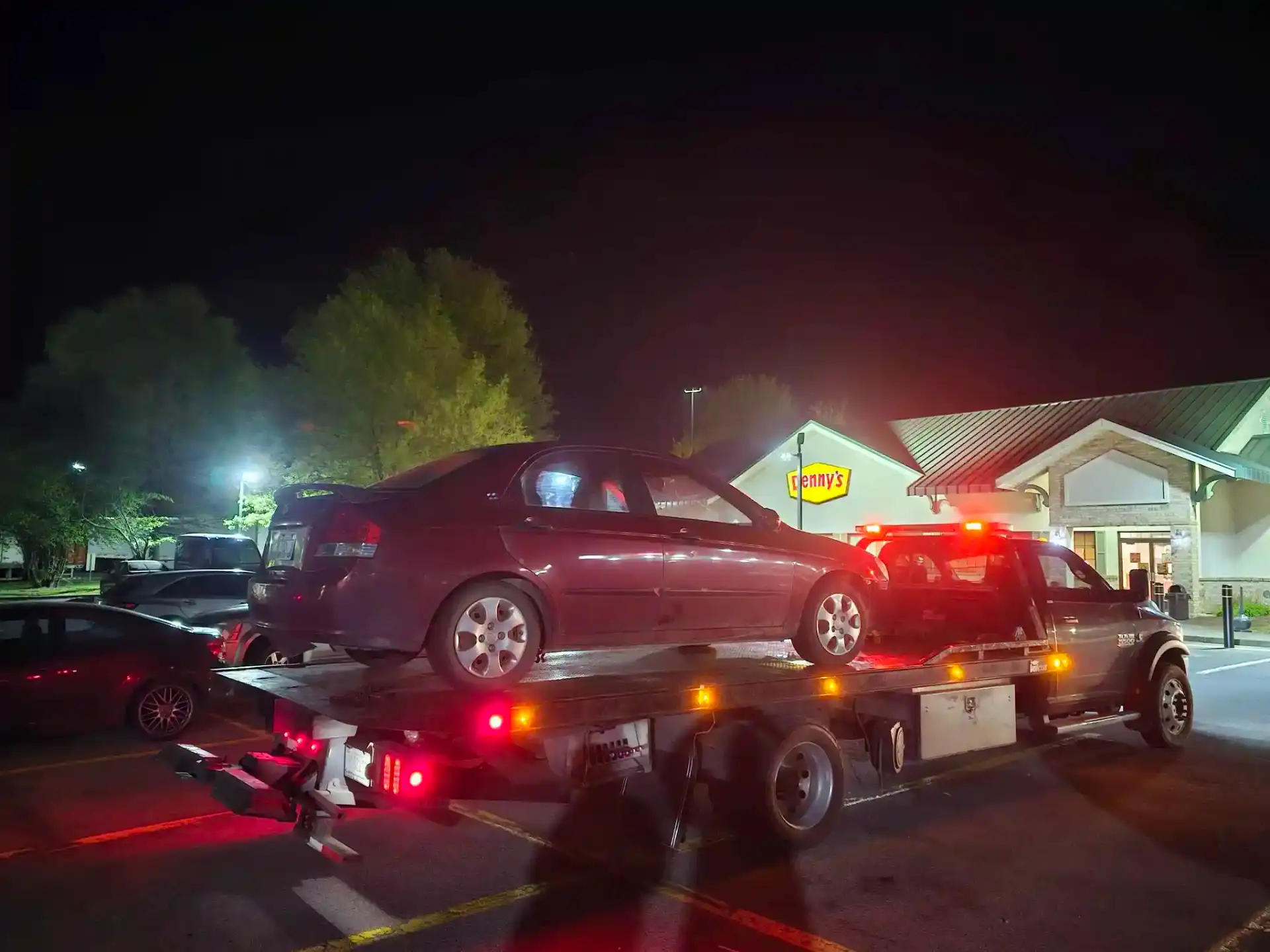
- Once stopped, do not drive again until the brakes have fully cooled and you've tested them. Fluid fade recovers when the steam condenses, but glazed pads or warped rotors do not. Call for a flatbed.
Why a Brake Failure Always Gets a Flatbed
When we get the "no brakes" call, the truck that rolls is a flatbed. Three reasons:
- A car with faded or failed brakes can't be safely driven onto a wheel-lift staging position. Even a 5 mph creep into the loading area is dangerous if the pedal isn't predictable.
- Towing the car wheels-down means the failed brake system is the only thing standing between the car and the back of our truck on every stop. That's not a margin we work with.
- Once the brakes cool, the customer's natural instinct is to "test them and see if they're fine." A flatbed removes that temptation and gets the car to a shop where the cause — fluid, pads, rotors, or a hydraulic failure — can be diagnosed without putting anyone on the road.
When a critical safety system has failed, all four wheels off the ground is the only responsible call — book a Nashville flatbed tow instead of risking a wheel-lift ride to the shop.
Prevention: The 5-Minute Annual Check
The brake checks you can do yourself in five minutes that prevent almost every fade event:
- Pad thickness. Look through the front wheel spokes at the brake pad. If you can see less than 1/4 inch (about a stack of three quarters) of friction material above the metal backing plate, replace them.
- Rotor surface. Glance at the rotor face through the spokes. Deep grooves, a lip on the outer edge, or a blue-tinted heat ring means the rotor is past its service life.
- Fluid level and color in the reservoir. Pop the hood, find the brake fluid reservoir, look at the level (between MIN and MAX) and the color. Fresh fluid is honey or light amber. Dark brown or black means it's overdue for a flush.
- Brake pedal feel. On a flat stretch with no one behind you, press firmly and hold. The pedal should stop at a consistent height and stay there. If it slowly sinks toward the floor while you hold it, you have a leak — internal or external — and the system is unsafe.
The Short Answer
Brake fade is heat, not damage — at first. Downshift before long descents, use firm short brake applications instead of a long drag, and never ride the pedal for more than a few seconds at a time on a grade. If you smell burning or the pedal softens, get off the brakes immediately and use the engine to slow the car. Old fluid is the hidden risk — flush it every three years. If the brakes fail outright, downshift, look for a runoff, use the parking brake gently, and once stopped, do not drive again. Call for a flatbed.
Hook Em' Up Towing dispatches flatbeds for brake failures 24/7 across Nashville and the surrounding ZIPs. Call (615) 756-5330 for a flatbed so the car can reach the shop without being driven further.
Stranded or Stuck? We're Ready.
Our dispatchers are standing by around the clock — one call and a truck is on the way