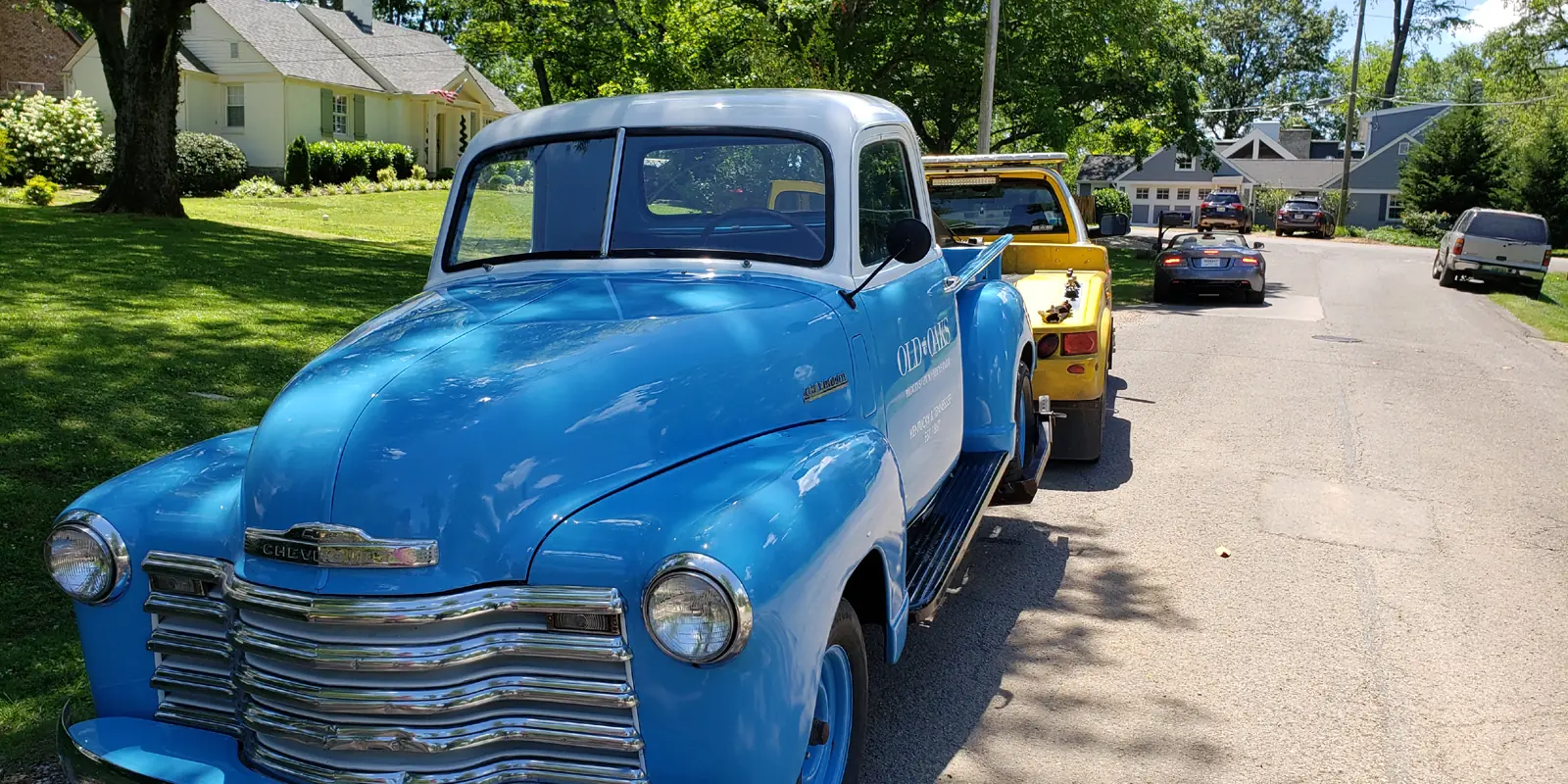
Classic car loaded on a Hook Em' Up Towing enclosed-style flatbed in Nashville TN

Page image supporting Enclosed vs Open Trailer: Classic Car Transport Guide. When enclosed transport is worth the premium, when open is fine, and the five…

Back to Blog
Classic & Exotic Transport

Enclosed vs Open Trailer: Classic Car Transport Guide

When enclosed transport is worth the premium, when open is fine, and the five questions an operator uses to decide which trailer protects your car.

Hook Em' Up Towing TeamPublished May 9, 2026

The single most common question I get from owners shipping a classic, exotic, or restored car is whether to use an open trailer or an enclosed one. The honest answer is that it depends on the car, the route, and what the car is for — but the trade-offs aren't what most owners assume. Here's the operator's view, after loading hundreds of collector cars on both kinds of equipment.

What "Open" Actually Means

An open auto-transport trailer is the kind you've seen on the interstate hauling six or eight cars stacked on two decks. It's the workhorse of the new-car business and 90% of consumer auto transport happens on one. The car rides exposed to weather, road debris, and anything that falls off another vehicle. For a daily driver moving across the country, the cost-per-mile advantage is substantial — often 30–40% cheaper than enclosed.

The exposure is real but limited. In dry weather on a clean interstate, an open trailer is fine. In wet weather, your car arrives covered in road grime, salt spray, and whatever was on the trailer ahead of it. After a 1,200-mile haul through three states, the wash bill is real.

For a single-car move within Tennessee or to a neighboring state, an open one-car flatbed is usually what you want — that's our flatbed-towing service and it's what nearly every Nashville-to-Atlanta or Nashville-to-Memphis classic move uses. The car is on a single deck, no other vehicles above or below it, and it's never out of sight of the operator.

What Enclosed Adds

An enclosed trailer is a hard-sided box, sometimes a soft-sided curtain, with the cars sealed inside. The premium isn't just weather — it's everything you don't see:

  • No road debris. A single rock kicked up by a semi at 70 mph will chip a clear-coat repaint. Enclosed eliminates that.
  • No public visibility. A six-figure car on the interstate is a target. Inside an unmarked enclosed trailer, no one knows what's in there.
  • Lift-gate loading. Most enclosed trailers use hydraulic lift gates instead of ramps, which matters for low-clearance cars where even a 5° approach angle scrapes the splitter. (We covered the geometry in detail in why lowered cars need zero-angle loading.)
  • Climate control on premium rigs. Top-tier enclosed haulers run dehumidified trailers — a real factor for a fully restored car going to a concours.
  • Lower vehicle count. A two-car or four-car enclosed trailer means your car is one of two or four, not one of eight, and the loading sequence is more controlled.

You pay roughly 50–100% more for enclosed over open on the same route. Whether that math is worth it depends entirely on the car.

The Decision Framework I Use

Owners ask me which to pick, and I run them through five questions:

1. What did you pay for the car? A car worth $30,000 or less almost never justifies enclosed transport on its own — the price difference is too large a percentage of the asset value. Above $80,000, the enclosed premium is small enough relative to the car that there's no reason not to take it. Between $30,000 and $80,000, the answer is route-dependent.

2. Is the paint original or restored? Original survivor paint is irreplaceable — a single chip costs nothing to repair on a modern car and ruins the value of a survivor. Restored paint is replaceable but expensive ($8,000–$25,000 for a full respray). Daily-driver paint is fine on open.

3. Is the car drivable? A non-running car has to be winched onto the trailer. Enclosed trailers with lift gates handle this gracefully. Open trailers can do it too, but the loading angle is steeper and the winch path is less controlled.

4. How long is the haul? Anything under 250 miles, weather is predictable enough that an open flatbed is usually fine. Anything over 1,000 miles, you're crossing weather systems you can't predict, and enclosed becomes worth the premium even on a mid-value car.

5. Where is the car going? If the destination is a concours, an auction, or a buyer who's never seen the car in person, enclosed protects the first-impression value. If it's going to your garage to be torn down for restoration anyway, open is fine.

What "Door-to-Door" Actually Looks Like

Most long-distance auto-transport listings advertise door-to-door pickup and delivery, but the practical reality varies. Big enclosed trailers (45–53 feet) physically can't enter most residential streets. The actual pickup point is usually the closest commercial parking lot — a Lowe's, a Cracker Barrel, a wide turn-around. For Nashville pickups, that often means a meet point off the interstate, not the curb in front of the seller's garage.

Single-car enclosed haulers are more flexible — they can usually get to a residential driveway as long as there's room for the gate to drop. If the car is in a tight subdivision or behind a gate, mention that when booking.

For routes outside Tennessee, our long-distance transport service coordinates the pickup logistics and the route. We can quote both open (cheaper, single-car flatbed) and enclosed (premium, contracted carrier) for the same route so you can see the actual price difference for your specific haul.

Insurance: What's Actually Covered

Both open and enclosed carriers carry cargo insurance, but the per-vehicle limits matter. A standard open multi-car carrier might have $250,000 total cargo coverage spread across 8 cars. If your car is worth $80,000 and the trailer is hauling it with seven other cars worth $30,000 each, your share of the limit is barely covering you in a total loss.

Enclosed specialty carriers typically run $500,000–$1,000,000 per-trailer coverage with lower vehicle counts, which is part of what you're paying for. Always ask for the certificate of insurance with your VIN listed before the car loads. If the broker won't provide it, find another broker. For our specialty classic car towing work, the certificate goes to the owner before the car leaves the loading point.

The Short Answer

If the car is irreplaceable, enclosed. If the car is replaceable but expensive, enclosed for hauls over 1,000 miles, open for hauls under 250 miles, and ask about both for the middle. If the car is a project, driver, or going to be torn apart on arrival, open every time.

Hook Em' Up Towing handles in-state classic and exotic moves on covered single-car flatbeds and partners with vetted enclosed carriers for out-of-state work. Call (615) 756-5330 and we'll quote both.

Hook Em' Up Towing — Nashville's Trusted Choice

Locally owned since 2010, serving every Nashville neighborhood with fast, fair service