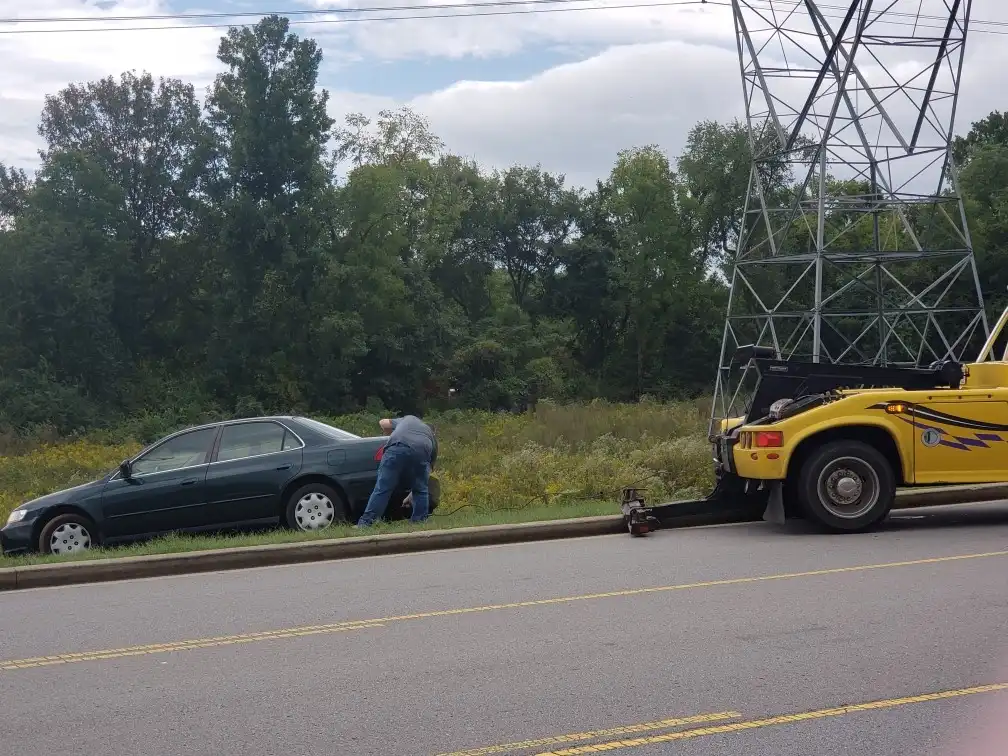
Why Vehicles Get Stuck: Recovery Physics & Self-Rescue Tips
The physics of traction loss, why DIY strap recoveries cause damage, self-rescue techniques that work, and Nashville's worst stuck-vehicle hotspots.
Nobody wakes up thinking "today's the day I get stuck in a ditch." But in Nashville, where afternoon thunderstorms roll in without warning and some of the back roads are more mud than pavement after a good rain, it happens to all kinds of drivers in all kinds of vehicles.
This guide explains the physics of why vehicles get stuck, the terrain factors that turn a minor slide into a serious recovery, and — critically — why amateur extraction attempts cause more damage than the original incident.
The Physics of Getting Stuck
Understanding why your vehicle won't move helps you understand why certain recovery methods work and others make things worse.
Traction loss is the fundamental issue. Your tires need friction with the ground surface to convert engine torque into forward motion. Mud, wet grass, ice, and loose gravel all reduce the friction coefficient below the threshold needed to overcome inertia. Once the tires start spinning without grip, they dig into the soft surface, lowering the vehicle's chassis closer to the ground and further reducing available traction. It's a negative feedback loop — every second of wheel spin makes the situation worse.
Weight distribution shifts compound the problem. When a vehicle slides into a ditch, the weight shifts downhill toward the lowest point. This unloads the uphill wheels (reducing their traction) while overloading the downhill wheels (which are usually in the softest ground). A front-wheel-drive car in a ditch has the worst of both worlds: the drive wheels are often lifted or sitting on the slickest surface.
High-centering happens when the vehicle's frame or undercarriage rests on a solid surface — a median, a rock, a compacted dirt ridge — while the wheels hang slightly above the ground. No amount of throttle will help because the drive wheels aren't carrying enough weight to generate traction. This is common in parking lot mishaps where drivers pull too far forward over a curb or landscaping island.
Nashville's Most Common Stuck-Vehicle Scenarios
Rain-slicked road slides account for the majority of local recoveries. Nashville gets 47 inches of rain a year, and when it comes down fast, oil on the road surface mixes with water to create an incredibly slippery film — especially in the first 15 minutes of a storm. The most common slide locations: curvy roads like Highway 100 through the Warner Parks, the hilly sections of Old Hickory Boulevard, and the steep grades around Radnor Lake.
Construction zone mud is Nashville's perpetual hazard. New developments, road work, and utility projects churn up dirt that turns to quicksand-like mud after rainfall. Drivers who cut through construction areas or park on unpaved surfaces near active sites end up stuck. The Antioch and Hermitage corridors see this frequently due to heavy residential development.
Winter ice slides are rare but devastating. Nashville's hilly terrain means one icy morning can send dozens of vehicles into ditches, off embankments, and into curbs simultaneously. Unlike northern cities with flat terrain, Nashville's grades turn even a thin ice layer into a serious traction hazard. Recovery volume triples during ice events.
Parking lot miscalculations are more common than people admit. Driving over a parking lot median, misjudging a landscaping island, or backing into a soft drainage ditch behind a strip mall. These are usually straightforward recoveries, but trying to power through them yourself often causes undercarriage damage that turns a $150 recovery into a $1,500 repair.
Why DIY Recovery Attempts Usually Backfire
The instinct to call a friend with a truck and a tow strap is strong. It's also how a lot of recoveries go from "stuck" to "stuck AND damaged." Here's what goes wrong:
Consumer tow straps aren't rated for vehicle recovery. They stretch under load and, when they snap, the elastic recoil can send a metal hook through a windshield. Recovery straps (which are designed to stretch and absorb energy gradually) are different from tow straps (which are designed to remain rigid). Most people don't know the difference and use whatever's in the garage.
Wrong attachment point is the most expensive mistake. Hooking a strap to a bumper cover, a tow hitch receiver without a properly rated D-ring, or a random frame crossmember invites disaster. Bumper covers are plastic — they rip off ($800 to $2,000 to replace). Suspension components bend. Frame rails can crack if the pull angle creates a lateral force they weren't designed to handle.
Every vehicle has manufacturer-designated recovery points — specific reinforced locations engineered to handle multi-directional pulling forces. They're usually marked with a small arrow or hook icon stamped into the frame. If you don't know where yours are, check your owner's manual. Professional recovery operators identify these points before connecting any equipment.
Wrong pull angle can flip a vehicle, drag it sideways into a worse position, or snap the recovery vehicle's transmission. The angle of pull relative to the stuck vehicle's center of gravity, the slope of the terrain, and the surface condition all factor into the physics. A straight pull on flat ground is simple. A 30-degree uphill pull on a mud-covered embankment requires careful calculation that accounts for the vehicle's tendency to yaw (rotate horizontally) under asymmetric load.
People get injured. Standing near a tensioned cable or strap that fails is genuinely dangerous. The energy stored in a stretched strap is enormous — a 10,000-pound load on a 20-foot strap stores enough energy to be lethal if it releases suddenly. Every year, people are seriously injured or killed in amateur recovery attempts. Professionals stand clear of the tension zone and use dampeners (heavy blankets draped over cables) to absorb energy if a line breaks.
Self-Rescue Techniques That Actually Work
Before calling anyone, there are a few things worth trying — but only if conditions are safe:
Stop spinning immediately. This is the single most important instruction. Every second of wheel spin digs you deeper and overheats your transmission. If the wheels are spinning and the vehicle isn't moving, you're making things worse.
Rock the vehicle. Shift between drive and reverse in short, controlled bursts — not gunning the engine, but gently applying throttle just enough to move the vehicle a few inches in each direction. Each rock extends the cleared path slightly. This works in light mud or shallow snow but not in deep ruts.
Reduce tire pressure. Dropping tire pressure to 15-20 PSI (from a typical 32-35 PSI) flattens the tire's contact patch, spreading the vehicle's weight over a larger area and increasing traction. This is a legitimate off-road technique. But you'll need a way to re-inflate afterward — a portable compressor or a nearby gas station.
Create traction with materials. Floor mats, cardboard, cat litter, or gravel placed directly in front of (or behind) the drive wheels can provide enough grip to break free. Wedge the material as far under the tire as possible. This works best on flat surfaces where you just need initial traction to get moving.
Know when to stop. If rocking, pressure reduction, and traction aids don't work within three or four attempts, continuing will only dig the vehicle deeper and risk transmission damage. At that point, professional equipment is the cost-effective choice.
What Professional Recovery Looks Like
Professional winch-out service uses an industrial-grade motorized winch mounted on a recovery truck, rated for 10,000 to 20,000 or more pounds of pulling capacity. The cable connects to the stuck vehicle at manufacturer-designated recovery points — the correct ones, not wherever looks convenient.
The pull is slow, controlled, and steady — typically two to four feet per minute. The operator adjusts the cable angle as the vehicle moves, compensating for terrain changes and preventing the vehicle from swinging sideways. After extraction, a quick undercarriage inspection confirms nothing was damaged during the incident — bent tie rods, cracked oil pans, and torn wheel well liners are common findings that need attention before driving.
What to Do Right Now If You're Stuck
Stop spinning your wheels. You're digging deeper and potentially overheating your transmission.
Turn off the engine if you smell anything burning or see smoke from the wheel area.
Stay safe. If you're near traffic, stay inside with your seatbelt on. If you slid into a ditch on a highway, get behind the guardrail if there is one.
Call (615) 756-5330. Tell us exactly where you are — drop a GPS pin on your phone map if possible. Describe your vehicle and how it's stuck. We'll give you a clear price and an ETA before we roll.
Don't risk your safety or your vehicle trying to muscle it out yourself. That's what professional equipment and trained operators are for.
Hook Em' Up — Nashville's Trusted Choice
Locally owned since 2010, serving every Nashville neighborhood with fast, fair service