Page image supporting How to Get a Car Unstuck From Mud or Snow Safely. Why spinning the wheels makes it worse, the rocking technique that actually works,…
Getting Free From Mud and Snow Without Wrecking Your Car
Why spinning the wheels makes it worse, the rocking technique that actually works, traction aids that help, and when to stop and call for a winch.
A car stuck in mud, snow, or a soft shoulder is one of the most common calls I run after rainstorms and the rare Nashville snow event. Most of the time, the driver tried something first that made the situation worse — buried the wheels deeper, smoked a clutch, or rocked the transmission until something gave up. Here's the operator-side view of what actually works, what doesn't, and when you should stop and pick up the phone.
Why Spinning the Wheels Almost Always Makes It Worse
When a tire spins on a low-traction surface, two things happen at once. The tire melts the surface under it (snow becomes ice, dirt becomes slick clay) and the spinning rubber digs straight down. After about thirty seconds of full-throttle spinning, you've usually traded a one-inch problem for a six-inch one.
The other failure mode is heat. An automatic transmission dumping torque into a stationary tire builds heat in the torque converter fast — fluid temps can climb past 250°F in under a minute. That's the temperature where transmission fluid starts to oxidize and clutches start to glaze. I've pulled cars out of mud where the bigger repair bill ended up being a transmission flush, not the tow.
If you've spun for more than ten or fifteen seconds and the car hasn't moved, stop. You're not stuck because you need more throttle. You're stuck because the tire has nothing to grip.
The Rocking Technique (When It Actually Works)
Rocking only works if you're sitting in a small depression — a couple of inches deep, not a real hole. The idea is to use the car's own momentum to climb out the same way it went in.
Put the car in drive, ease forward until the wheels start to slip, then immediately shift to reverse and ease backward to the same point. Do not punch the throttle. Each cycle, you're trying to get a few more inches of travel. After three or four cycles, you'll either be free or you'll have proved the hole is too deep to climb out of.
Two things will turn rocking into damage. First, slamming between drive and reverse without letting the car come to a complete stop wrecks transmission bands. Always pause for a beat at the bottom and top of each cycle. Second, modern automatics with traction control will cut power as soon as wheel slip is detected. If your car has a "snow mode" or a button to disable traction control, that's the time to use it — controlled wheel slip is exactly what rocking needs.
Traction Aids That Actually Help
The cheapest thing that works is whatever you can put under the drive wheels to give the tire something solid to bite. In order of how often I see it actually free a car:
- Floor mats — Pull the rubber floor mats from inside the car and wedge them under the drive tires, textured side up. They're disposable for this purpose. You'll probably ruin them but you'll save a tow.
- Tree branches, gravel, or boards — Anything that gives the tire something rigid to push against. Avoid pine straw and dry leaves — they slip worse than snow.
What doesn't work: pouring water on snow (it freezes and makes it worse), hot water on ice (same outcome thirty seconds later), or trying to dig a "ramp" without packing the surface — loose dug material has less traction than what was there before.
When You Need a Winch, Not a Push
There's a clear line between "stuck" and "needs recovery equipment," and most drivers don't see it until they've spent an hour digging. Call for a winch-out service when any of these are true:
- A wheel is fully buried past the rim
- The undercarriage is resting on the ground (the car is "high-centered")
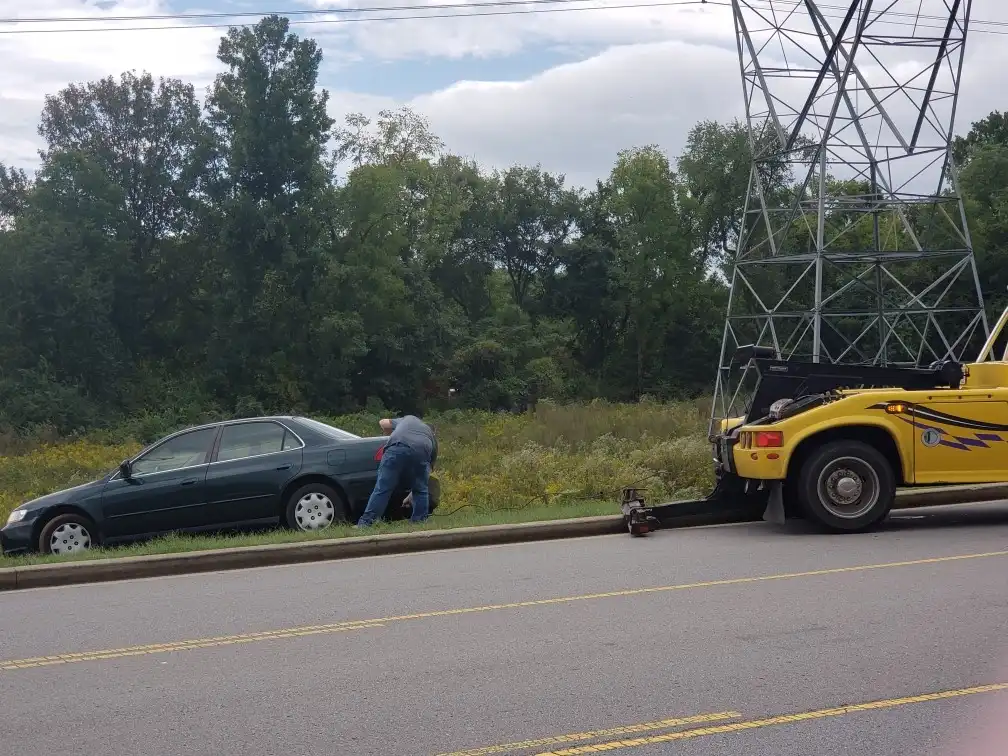
- You're in a ditch, soft shoulder, or grass median
- The car has slid down an embankment
- You can't see the bottom of the tires through the mud or snow
Recovery work is what a winch is built for. A truck-mounted winch generates 8,000–12,000 pounds of pull along a controlled line — way more than you can produce by spinning a 200-horsepower engine through a 50% traction loss. More importantly, a recovery operator chooses the pull angle so the car comes out without scraping the bumper, ripping the splitter, or damaging suspension components.
If the car ended up off-road entirely — down a ravine, in a creek bed, deep in a field — that's off-road recovery, which uses different rigging and sometimes a second anchor truck.
Don't Let Strangers Pull You With a Strap
I see this on Nashville back roads after every snowstorm. A pickup driver pulls over, hooks a tow strap to your bumper, and yanks. Two things go wrong consistently. The bumper isn't a recovery point on most modern cars — it's a plastic cover over a foam crash absorber, and it tears off cleanly under load. And tow straps without proper recovery hooks can snap and become projectiles. People get killed by failed recovery straps every year.
Use only attachment points and procedures identified in the vehicle manufacturer's current instructions. If you cannot verify them, stop and call a qualified recovery provider.
What to Do While You Wait
Turn the wheels straight. Put the parking brake on if you're on a slope. Stay in the car if you're near traffic. If you ran the engine while spinning, let it cool for five minutes before the truck arrives — overheated transmissions sometimes throw codes that clear once temps drop, and a cool engine is easier to recover safely.
If you're not sure whether you're stuck-stuck or just-need-a-push stuck, send a photo when you call. We can usually tell from the picture whether it's a winch job or a five-minute push, and we'll dispatch the right truck the first time.
Hook Em' Up Towing is at (615) 756-5330, 24/7; dispatch will give you a current arrival estimate when you call.
Hook Em' Up Towing — Nashville's Trusted Choice
Towing and roadside assistance across Nashville, available 24/7