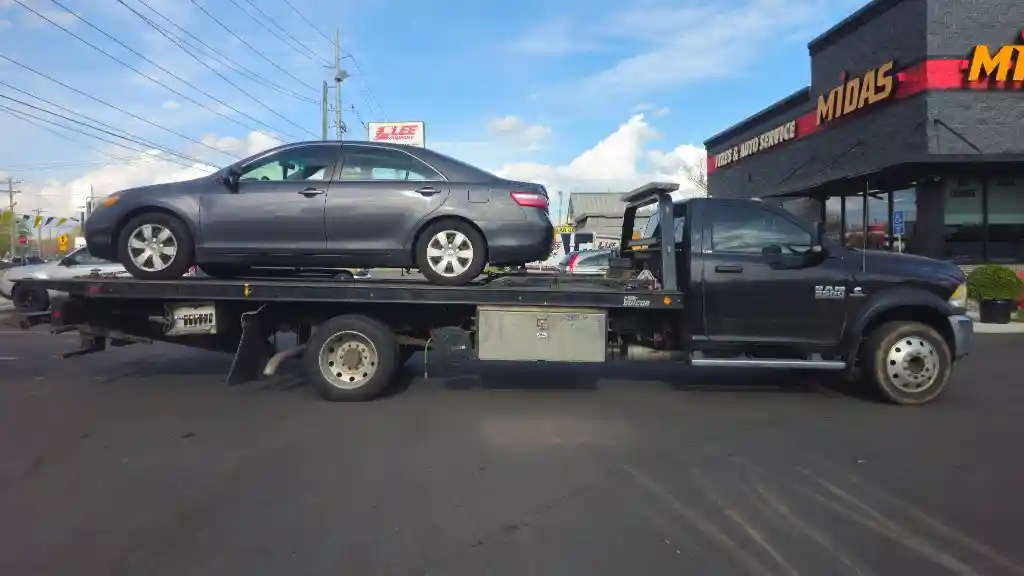
Page image supporting How to Check Tire Health: Tread, PSI and Blowout Prevention. Nashville roads destroy tires. Learn tread depth checks, correct PSI, p…
Reading Your Tires: Tread, PSI & Early Blowout Warnings
Nashville roads destroy tires. Learn tread depth checks, correct PSI, pothole avoidance, and the warning signs before a blowout strands you.
Nashville is rough on tires, and that's not really up for debate. Between the potholes on I-440 that I'm pretty sure have their own zip code by now, the construction debris that comes with every new build south of Broadway, and the absurd curbs on some of the older East Nashville side streets, we change a lot of flats in this city.
But here's the part most drivers miss: most blowouts don't actually come out of nowhere. The tire was telling on itself for weeks. You just had to know what to look at.
This is the article I wish I could hand to every customer before they end up calling me from the shoulder of I-65 with their hazards on. It's the inspection routine I actually use, the local hazards that cause the most damage, and the cheap maintenance that prevents almost all of it.
The penny test is fine. It's also outdated.
You've heard it: stick a penny upside-down in the tread, and if you can see the top of Lincoln's head, replace the tire. That's not wrong, exactly. It tells you when the tire has hit the legal minimum of 2/32" of tread. The problem is that's already too late if your goal is staying on the road in the rain.
Tires start losing meaningful wet-weather grip well before they're "bald." Somewhere around 4/32", the grooves can no longer push water out fast enough at highway speed, and you start hydroplaning on roads you used to handle fine. I-24 and I-440 have a few notorious low-drainage stretches where this matters more than people realize.
The better tool is a $5 tread depth gauge from any auto parts store. Measure in three places across the width of the tire — inside, middle, outside — and at three or four spots around it. You're not just looking for a number, you're looking for the pattern.
If only the inside edge is worn, your camber is off or your ball joints are tired. We see that constantly on cars that've taken a few hard pothole hits. Outside-edge wear means the opposite — usually a lowered car or somebody who corners hard. Center-only wear means the tire's been over-inflated and ballooning in the middle. Both edges worn but the center fine? Under-inflation. Sidewalls are doing work they aren't supposed to do.
If you replace the tire without fixing what caused the wear, the new tire wears the exact same way. I see it all the time.
Tire pressure is the number that runs everything
Pressure changes ride, fuel economy, braking distance, how long the tire lasts, and how likely it is to come apart at speed. And almost nobody checks it until the dashboard light comes on, by which point you're 25 percent or more under spec.
Two things to know.
The right number is on the door jamb, not the sidewall. The number molded into the tire is the maximum that tire can handle. The number on the sticker inside your driver's door is what your car was actually engineered to ride on. Those numbers are sometimes 10 or 15 PSI apart. Don't inflate to the sidewall.
Temperature matters more in Nashville than people realize. Tire pressure drops about 1 PSI for every 10°F the air drops. We go from 95° in August to 25° on a January morning. That's a 7 PSI swing — enough to put a perfectly fine summer tire below the warning threshold the first cold morning of the year. That's also why the TPMS light tends to come on overnight in November even when nothing's actually wrong with the tire.
And check pressure cold. Driving warms the tire and inflates it 3 to 5 PSI, which masks under-inflation. First thing in the morning, before the car has moved, is the honest reading.
What's actually killing tires in Nashville
Potholes are the headline. We are consistently one of the worst Southeast cities for road surface, and I-440 between West End and I-65, Dickerson Pike north of Trinity, and the Woodbine stretch of Nolensville are basically tire graveyards. A direct hit at speed can blow the tire instantly, bend the rim, knock the alignment out, and tweak a strut, sometimes all on the same hit. Customers regularly underestimate how much damage a single bad pothole can do.
The quieter killer is construction debris. With as much building as Nashville is doing right now, there are screws, nails, wire scraps, and metal shavings on roads near every active site. These don't blow you out — they cause slow leaks. The classic sign is a TPMS light that comes on cold and disappears when the tire warms up. That tire has something in it. It's leaking when the rubber is stiff and sealing back up when it warms. Get it pulled and patched before it gets worse.
Curb strikes are sneaky. The sidewall is the thinnest, most flexible part of the tire and it's not designed to absorb impacts — it's designed to flex. A hard curb at parking speed can break internal cords without leaving a visible mark. Then weeks later, doing 65 on the interstate, the tire fails for "no reason." It had a reason. The reason was the curb in October.
Grade-level railroad crossings — the ones on Charlotte and Fatherland especially — punish the bead area where the tire meets the rim. Not catastrophic on any single crossing, but if you cross them every day for a couple years, those tires will tell.
Rotation is the cheapest insurance you're not using
Tire rotation every 5,000 to 7,500 miles is the single best maintenance dollar you can spend on a daily-driver car. On a front-wheel-drive, the front tires are doing both steering and driving, and they wear out a lot faster than the rears. Without rotation, you'll be replacing your fronts at 30,000 miles while the rears still have plenty left. With rotation, you replace four tires together at 50,000 to 60,000 and come out way ahead.
The pattern depends on the car. Front-wheel drive: fronts go straight back, rears cross to the opposite front. Rear-wheel or all-wheel drive: the reverse — rears go straight forward, fronts cross to the opposite rear. Directional tires (the ones with arrows on the sidewall) only swap front to back on the same side and never cross sides.
A lot of tire repair shops include rotation free with a tire purchase. If yours doesn't, it's $25 to $50, and the math still works out heavily in your favor.
Repair or replace?
Not every flat means a new tire. A puncture is repairable if it's in the tread (not the sidewall, not the shoulder), it's smaller than a quarter-inch across, the tire still has decent tread depth, and you didn't drive on it flat for very long.
The right repair is a combination patch-plug, installed from the inside of the tire after the tire's been pulled off the rim. That seals the puncture from both sides. A plug-only repair done without dismounting the tire is a road-trip patch — fine to get you home, not something to trust at highway speed for the next year.
Replace, no question, if any of these are true: the sidewall is damaged at all (sidewalls flex too much for any patch to hold), the puncture is bigger than a quarter, you drove on it flat for more than a short distance (the internal structure is wrecked even if it doesn't look like it), or the tire was already near the end of its tread life.
Nashville prices on replacement run roughly: $80 to $150 each for economy passenger tires, $150 to $300 for SUV and light truck, and $200 to $400+ for performance tires. If one tire's done and the others are heavily worn, replace in pairs on the same axle. Mismatched tread depths cause weird handling and on AWD cars they can actually damage the drivetrain over time. That's not a sales pitch, that's mechanical reality.
A five-minute monthly check
Pick a date — first of the month, payday, whatever sticks — and do this. It takes longer to find your tire gauge than to actually do the inspection.
Pressure on all four, plus the spare, cold, with a real gauge. Set it to whatever the door jamb says.
Tread depth at three places across each tire. Anything under 4/32" is on the clock.
Walk around and look at the sidewalls. You're looking for bulges (very bad), cracks, cuts, or fresh curb scuffs.
Eyes on the tread for embedded stuff — nail heads, screw heads, glass.
Check the spare. Is it still there? Is it still inflated? Spares lose air over time even when you never touch them, and finding out yours is also flat at 11 PM on the shoulder of I-65 is a bad night.
Five minutes a month. That's it. If something does go wrong on the interstate anyway, our I-65 breakdown guide walks through the safe sequence step by step.
If you can't change a flat yourself, you can request mobile spare-swap service and just stay in the car with your hazards on until we pull up. That's the safest move on any high-speed road.
Got a flat right now? Call (615) 756-5330 — we'll be there in 30 to 45 minutes and have you rolling on the spare before you know it.
Hook Em' Up Towing — Nashville's Trusted Choice
Locally owned since 2010, serving every Nashville neighborhood with fast, fair service