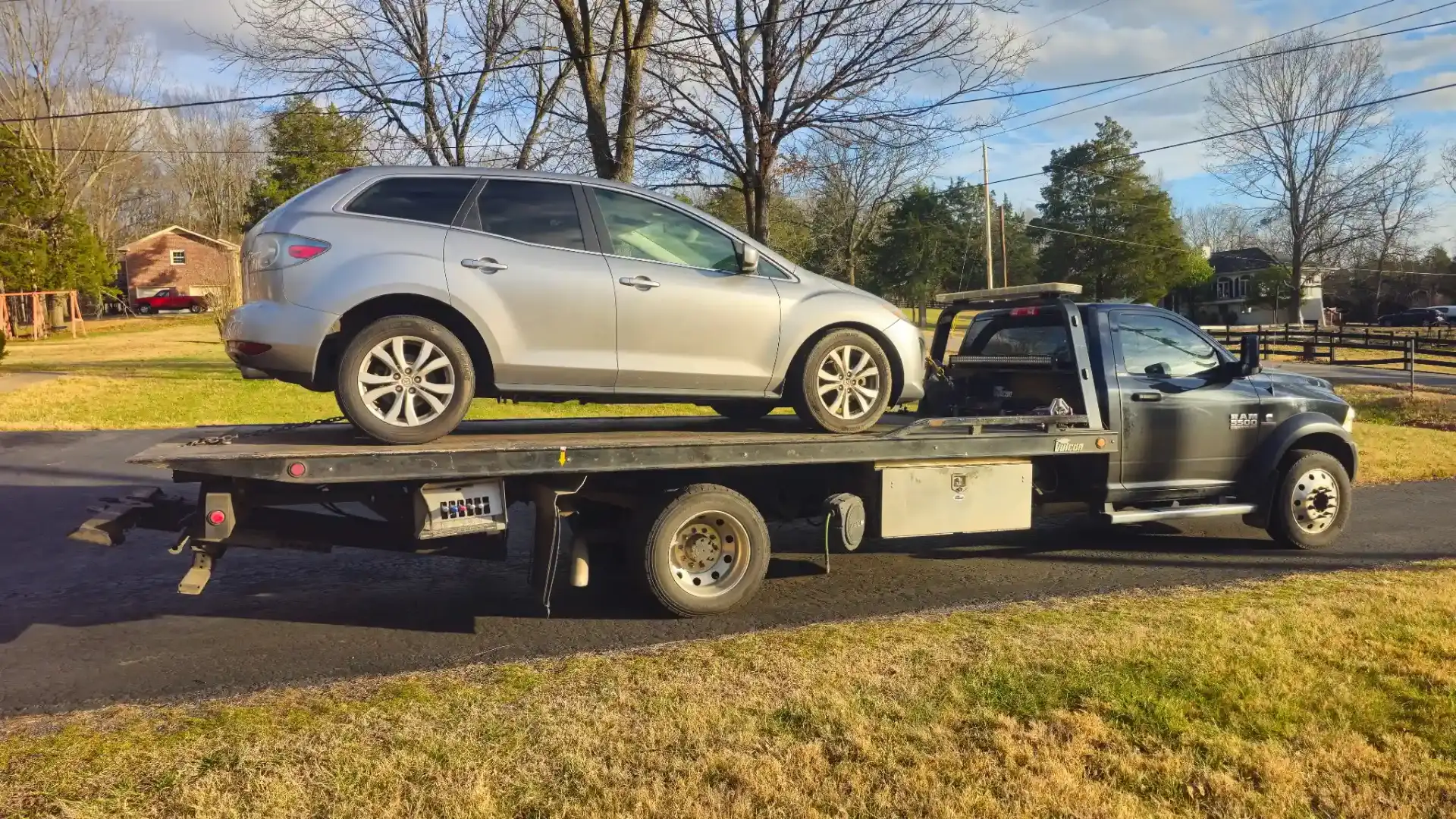
DIY Rope Towing Dangers: Why It Destroys Transmissions
DIY rope towing causes accidents, transmission damage, and legal trouble. Learn why professional towing is safer and cheaper.
I can't tell you how many times we've gotten a call that starts with "so, we were trying to tow it ourselves with a strap, and..." Nothing good ever follows that sentence.
I get it — your car breaks down, your buddy has a truck, and there's a tow strap in the garage. It seems like a simple, cheap fix. But after years of cleaning up DIY tow disasters across Nashville, I can tell you: it's almost never worth it. Here's why.
The Braking Problem Nobody Thinks About
When your car is being towed behind another vehicle with a rope, you're sitting in a car with almost no braking power. With the engine off, you lose power brake assist, which means you need to press the pedal 3-5 times harder just to slow down. Anti-lock brakes don't function without the engine running either.
Now add in the slack that builds up in a rope or strap. The lead vehicle brakes, your vehicle keeps rolling forward, the rope goes slack, and suddenly you're coasting toward your friend's tailgate with brakes that barely work. I've personally responded to calls where the towed car rear-ended the towing vehicle at intersections because the driver simply couldn't stop in time.
Steering Gets Dangerous Fast
Same problem with steering. Modern cars have power steering, and without the engine running, turning the wheel feels like arm-wrestling a bear. Making turns requires planning way ahead. Emergency maneuvers — swerving around a pothole, avoiding a pedestrian — are basically impossible. And the physical strain wears you out fast, which leads to worse decisions.
Ropes and Straps Break
Here's what keeps me up at night about DIY towing: when a strap breaks under tension, it recoils like a giant rubber band. I've seen a strap snap on I-40 and shatter the rear windshield of the towing truck, barely missing the driver. Consumer-grade tow straps aren't built for sustained vehicle towing. They degrade from UV exposure sitting in your garage, they're often rated for way less than your car weighs, and the attachment points — bumpers, random frame sections, tow hooks that aren't rated for pulling — can rip off without warning.
Your Transmission Won't Survive
This is the part that really costs people money.
Automatic transmissions need the engine running to pump fluid through the system. Without that lubrication, internal components grind against each other. Tow an automatic car with the drive wheels on the ground for 10-15 miles and you're looking at bearing damage. Go further and you're shopping for a new transmission — $3,000 to $8,000.
AWD and 4WD vehicles are even worse. The differential and transfer case can be destroyed within a few miles of improper towing. A lot of people don't even realize their vehicle is AWD until after they've done the damage.
Even manual transmissions, which are more forgiving, can suffer clutch and gearbox damage from prolonged rope towing.
It's Probably Illegal, Too
DIY rope towing in Nashville isn't just dangerous — it can get you cited. Tennessee law has specific requirements: minimum distance between vehicles (15 feet), a white flag or cloth on the tow connection, operational brake lights and turn signals on the towed car, a licensed driver in the towed vehicle at all times, and speed restrictions.
Get pulled over or cause an accident while doing a DIY rope tow and you're looking at traffic citations ($50-$500 per violation), possible reckless driving charges, and full liability for any damage or injuries. And here's the really painful part: your auto insurance almost certainly won't cover a DIY towing accident. You're on your own.
Real Nashville DIY Towing Disasters
These aren't hypothetical — they happened:
A Nashville driver tried to rope-tow his friend's car from the Briley Parkway interchange. The strap snapped during the merge, the disabled car hit the guardrail, and it caused a three-car pileup. Total damage: over $45,000.
A neighbor in Belle Meade towed a luxury SUV "just two miles" to a repair shop. Destroyed the AWD system. Insurance denied the claim because it was a DIY tow. Repair cost: $12,500.
A rope tow through downtown went sideways when the driver being towed couldn't steer around a pedestrian. The car jumped a curb and hit a parking meter. Both drivers faced charges.
"But It's Just a Short Distance..."
I hear this all the time. Doesn't matter. Transmission damage starts immediately — there's no safe distance for improper towing. Most accidents happen within the first mile. And "I've done it before without problems" doesn't mean the method is safe. It means you got lucky.
Let's Do the Math
| DIY Rope Tow Risk | Potential Cost | |---|---| | Transmission repair | $3,000-$8,000 | | Traffic citations | $50-$500 | | Damage to towing vehicle | $500-$5,000 | | Insurance premium increase | $500+/year | | Total potential damage | $4,050-$13,500+ |
| Professional Tow | Cost | |---|---| | Standard local tow | $85-$150 |
Professional towing costs about 1% of what a DIY disaster runs. That's not an exaggeration.
What to Do Instead
Call a professional. The math is overwhelmingly in your favor: a standard local tow runs less than a decent dinner out, and it comes with proper equipment, trained operators, and full insurance coverage. Compare that to the five-figure worst-case scenarios in the table above.
For situations that don't actually need a tow — dead battery, flat tire, empty tank, keys locked inside — a roadside assistance call handles it on-site in under 30 minutes. You drive away in your own car without it ever leaving the spot.
If you genuinely can't wait and need to move the car a very short distance (off a traffic lane into a parking spot, for example), push it manually with help from another person. Keep hazards on, stay off travel lanes, and never push alone — you need someone steering.
Car broke down in Nashville? Skip the rope. Call (615) 756-5330 and let us handle it the right way.
Stranded or Stuck? We're Ready.
Our dispatchers are standing by around the clock — one call and a truck is on the way